CICLORAMA
Fagis Giocs, Italy, 1966
This is a nice Italian game of which there are two different versions, as you can see. Thanks to the generosity of François Cardinet (and then his daughter Mathilde), I can compare both versions.
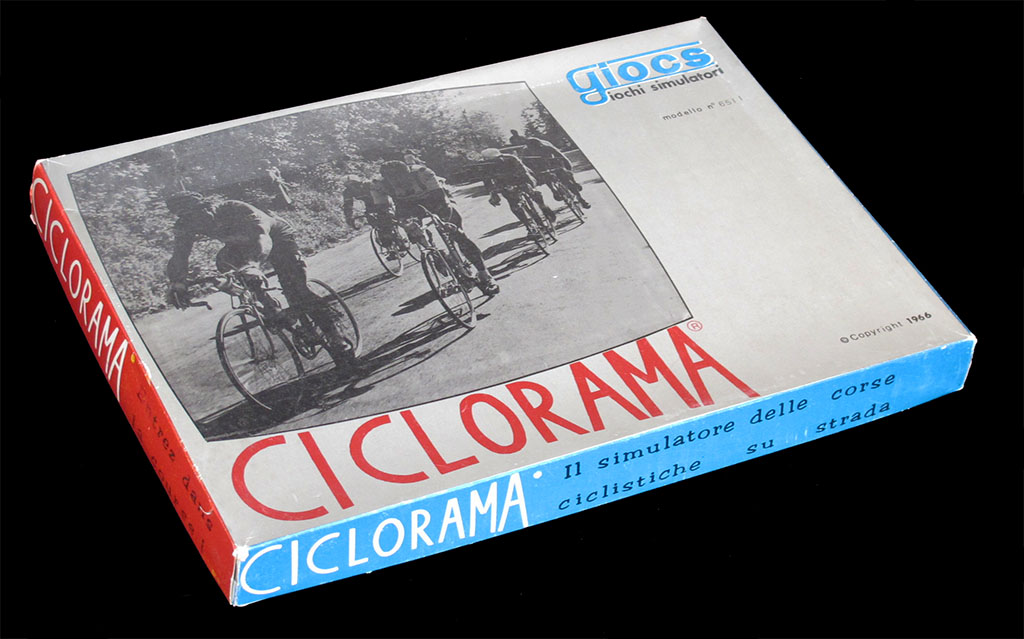
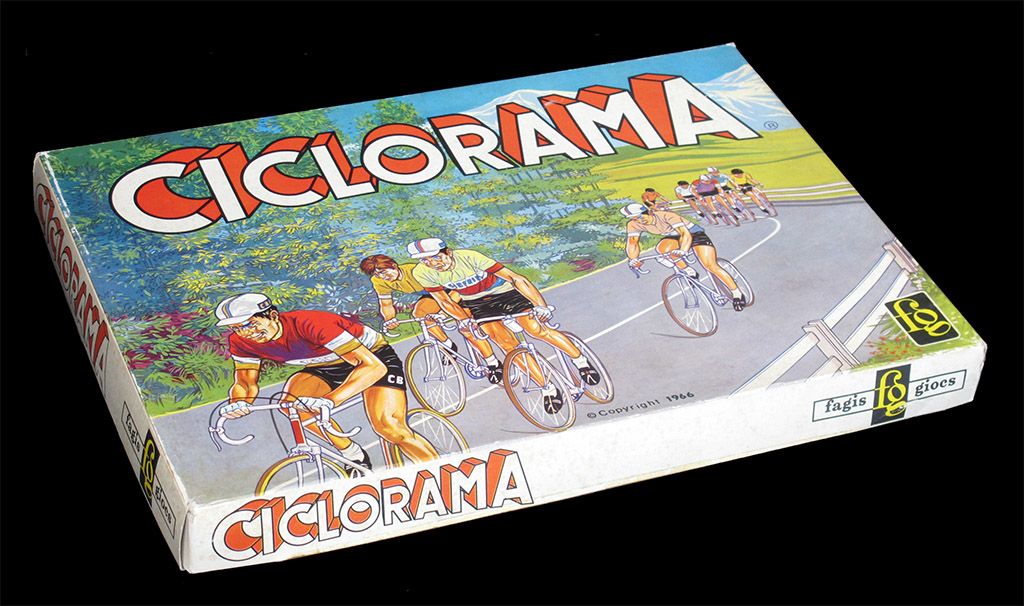
The first thing you notice, of course, is that the boxes, while being of exactly the same size (44 x 31 x 4 cm), look quite different and have the logo of a "different" game editor. The box with a multicoloured drawing is marked "Facis Giocs", while the box with a black and white picture is marked "Giocs. Giochi simulatori". (For those of you not familiar with Romance languages, "giocs" means "games", though not exactly in official Italian). To tell them apart, I will refer to them as the "Facis Giocs box" and the "giochi simulatori box". However, I think it is safe to assume that both games were made by the same Milanese company, the same one that made the game Cartosprint. Of course, if you know better, please let me know.
The rules of Ciclorama are trilingual (Italian, French and German). I would generally assume that, the game being Italian, in case of doubt the Italian rules should be the original ones. However, in the case of this game I am not sure, since there are some inconsistencies in the Italian rules (see below). The problems are is that the French translation is also problematic (it is clearly a translation, the idioms are sometimes wrong, and it mentions a "course contre la montre", which is clearly a mistranslation) and that my knowledge of German is not good enough to determine if the rules look like they could have been written in German first.
Whatever the original language, the rules are those of what I call "an ambitious game", one that wants to represent as many aspects of cycling races as possible. We find different types of terrains, and each rider has different abilities. The game is meant to represent a stage race, with classification by time and/or points, but it also can be used to play a single one-day race.
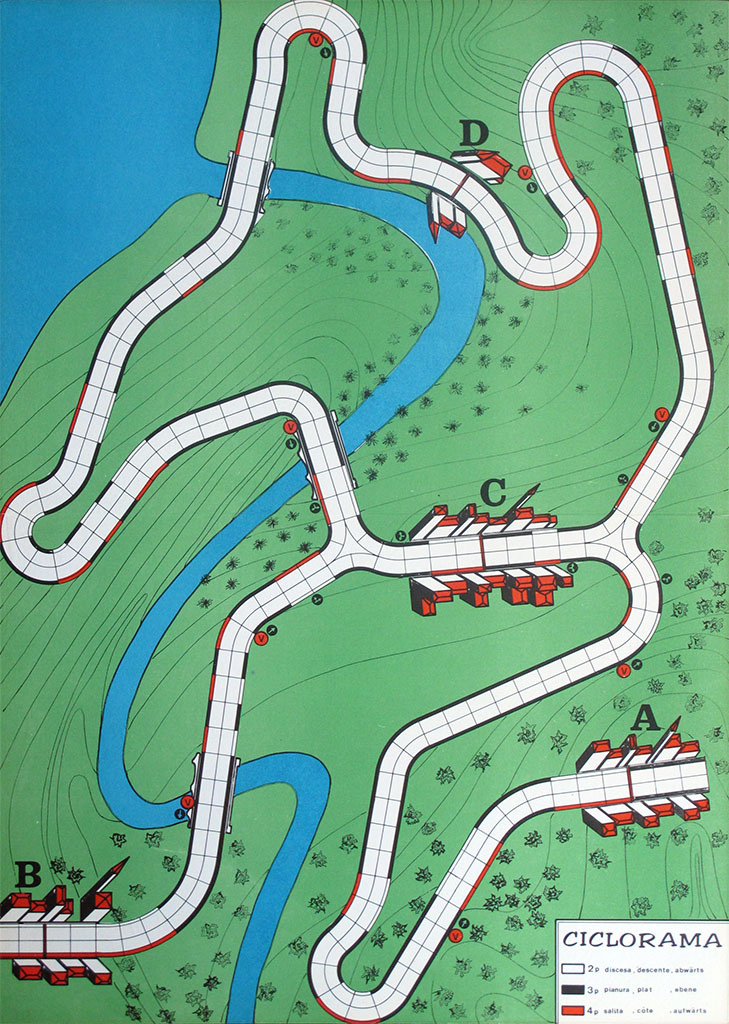
The board is exactly the same in both boxes, including the trilingual rule examples on the back. It is quite big (59.5 x 42 cm) and offers four different starting and finishing points so that different races can be run. The type of terrain is determined by the colour on the right (in the sense of the race, of course) margin of the road: black means a flat road, and it costs three points to move through it; red means a climb, and it costs 4 points; and white means descent, which is easier to ride and just costs 2 points. Furthermore, the circles marked with a V determine the sprint zones, which are not necessarily flat.
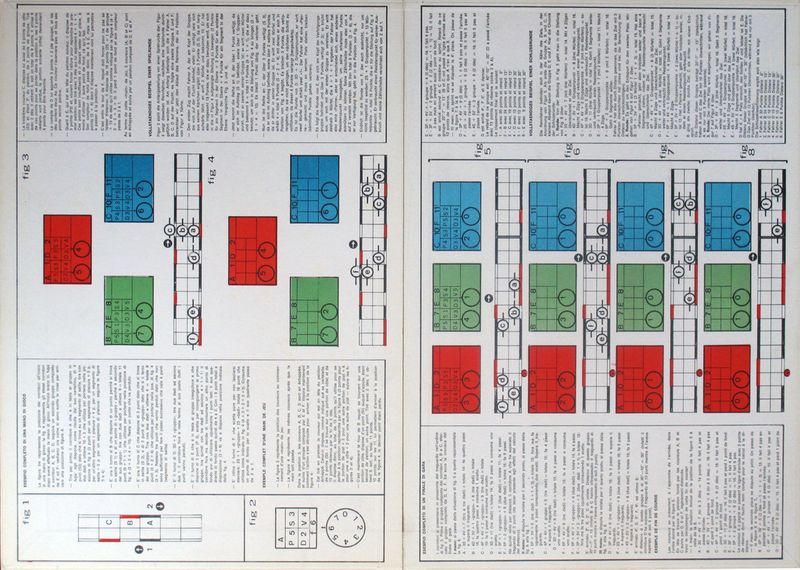
Back of the board. I hope you do not have to check the
examples during the race!
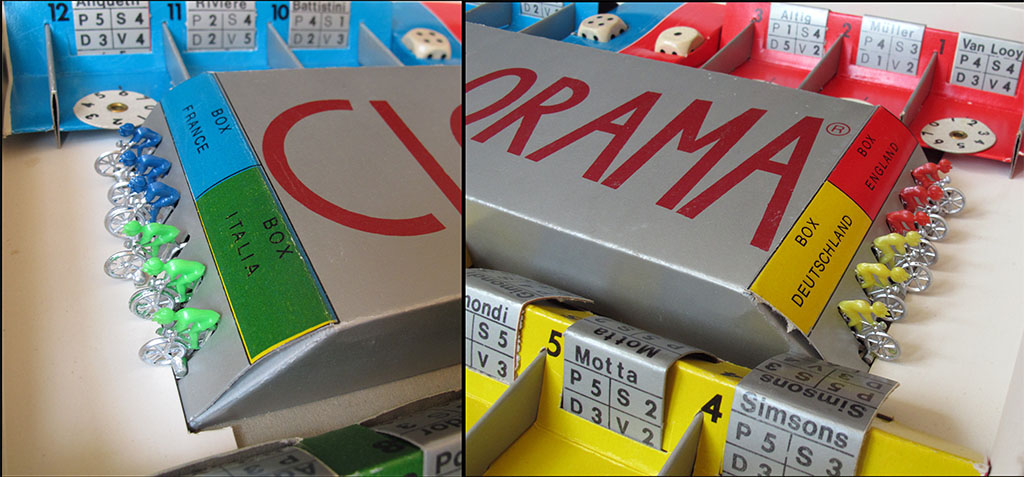
Each team consists of three riders. Each of these riders has different abilities. According to the Italian rules, riders' abilities are P=Pianura (flat road), S=Salita (climb), D=Discesa (descent), and V=fondo (endurance). Of course, V for "fondo" is a weird choice, especially if you compare it to the French and German rules, which have 5 different values for each rider. By a design feature, the fifth ability is hidden from sight. Check, for instance, Motta in the first picture below (or Gimondi and "Simsons" in the second), and you will discover the fifth value below the others. So, as correctly stated in the French and German rules, V is for sprint ("Velocità"), and "f" is for "fondo" (endurance). The "f" value marks the wheel position at the beginning of the race. If your rider has f=6, the race will start with the wheel at 6. This value decreases during the race.
In each turn, players choose whether they throw one or two dice. They may even choose to throw the three dice, but then they lose an endurance point. I would have guessed that throwing with just one die would give you back an endurance point, but it does not say so in the rules. The only interest of throwing just one die would be, then, to avoid the risk of throwing two ones, which causes a puncture. (Of course, a few cycling games pretend that slowing down to stay in the pack can be a good strategic choice, but it is very seldom the case in a dice game, and I do not see the interest in doing so either).
The rider abilities are added to the value thrown with the dice depending on the type of terrain. Some extra points are also added to the throw if the rider is protected from the wind (behind another rider). But this total sum is not the value by which the riders move, since different types of terrain need different values to move through them. You need two points to move a square on descents, three on flats and four on climbs. The possible remaining points are discarded.
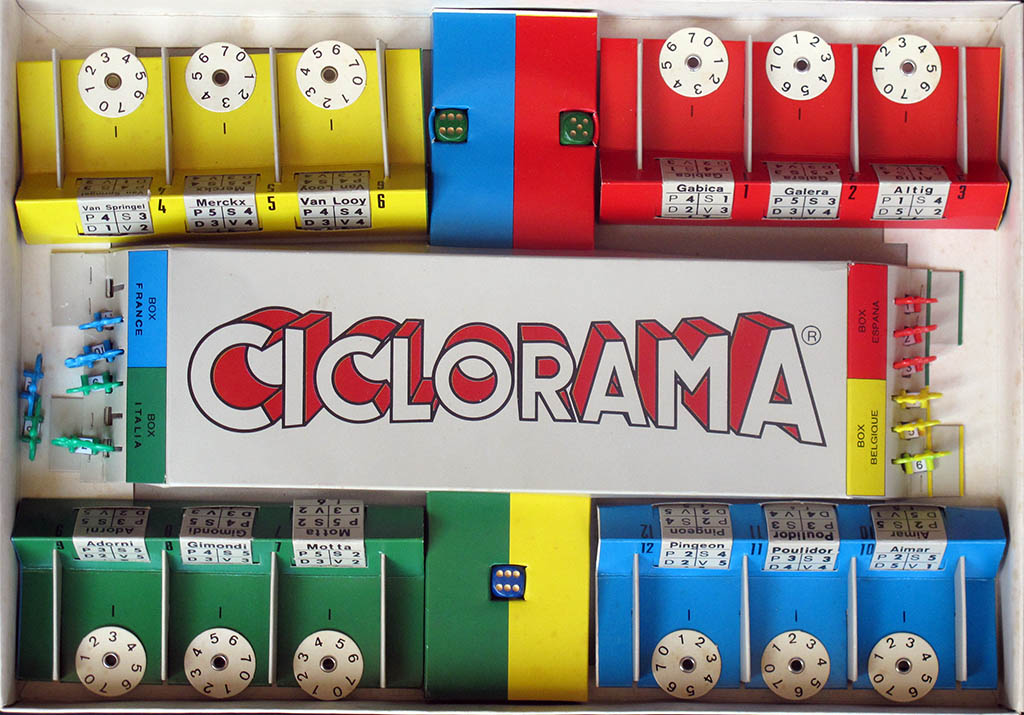
Contents of the "Facis Giocs" box
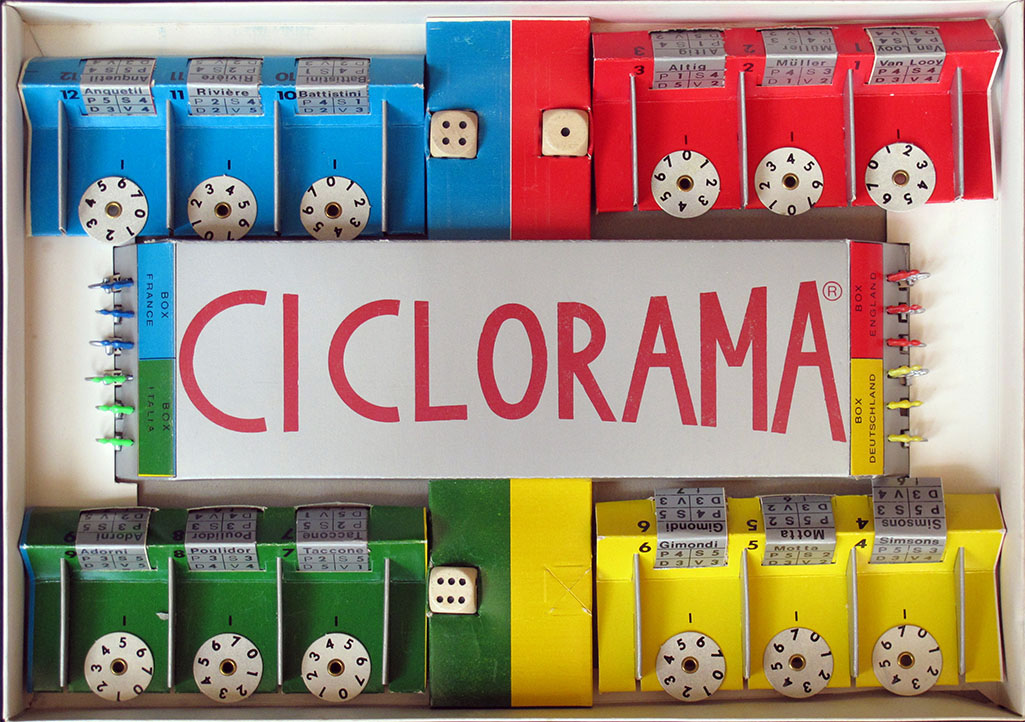
Contents of the "Giocs. Giochi simulatori" box
While the four teams in the "Facis" box are Italy, France, Belgium, and Spain, in the "Giochi simulatori" box Spain has been replaced by Germany. However, players can choose the cyclists on their teams regardless of the riders' nationalities. The Facis game features three French, Belgian, and Italian riders, as would be expected, but only two Spaniards and then a German, Rudi Altig, to complete the team. The "giochi simillatori" box, on the other hand, features five Italian riders, three French, two (?) Germans, one Belgian, and one Briton (assuming "Simsons" to be Tom Simpson).
The cyclists' selection makes me think that the "Facis Giocs" box is somewhat later. On the French "team", for instance, Pingeon et Aimar have replaced Anquetil and Rivière. The presence of Roger Rivière in a 1966 game is quite puzzling, since it is well-known that he had to quit cycling in 1960 after a crash.
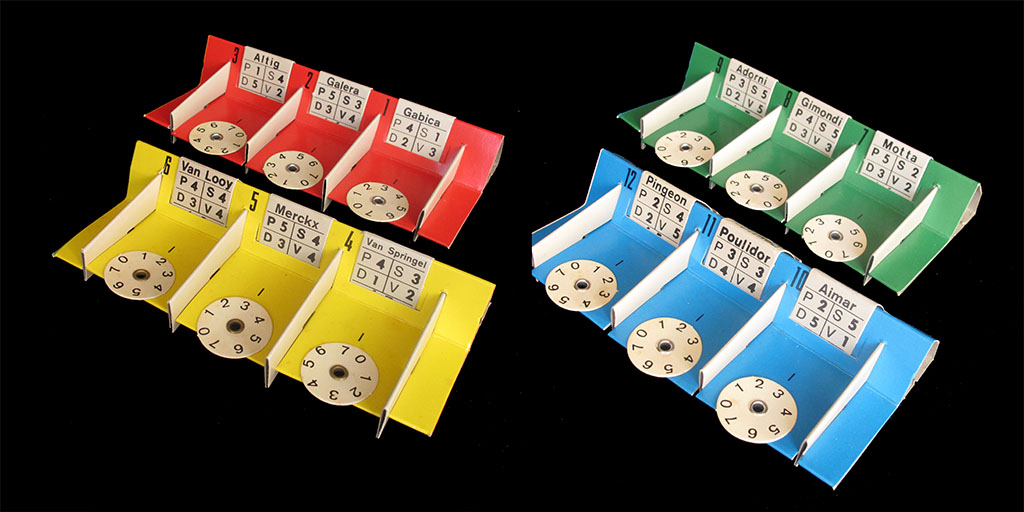
A couple of the Italian riders in the "giochi simulatori" box (Vito Taccone and Graziano Battistini) may not be that well remembered these days but were not a bewildering choice in an Italian game of the time. Battistini, furthermore, was well past his prime in 1966.
On the other hand, the selection of Spanish cyclists in the Facis box is rather unexpected. "Patxi" Gabica and Joaquín Galera were part of a younger generation of riders that replaced the older Bahamontes and Perez Francés, who no doubt would have been in this game if it had been made a little before, but in 1966 even Julio Jiménez would have been a more obvious choice for the Spanish team.
However, the rider that puzzles me is "Müller". I have mentioned "two Germans" in this box, but I am not sure who "Müller" can be (any ideas?), and therefore, saying that he is German is bold of me.
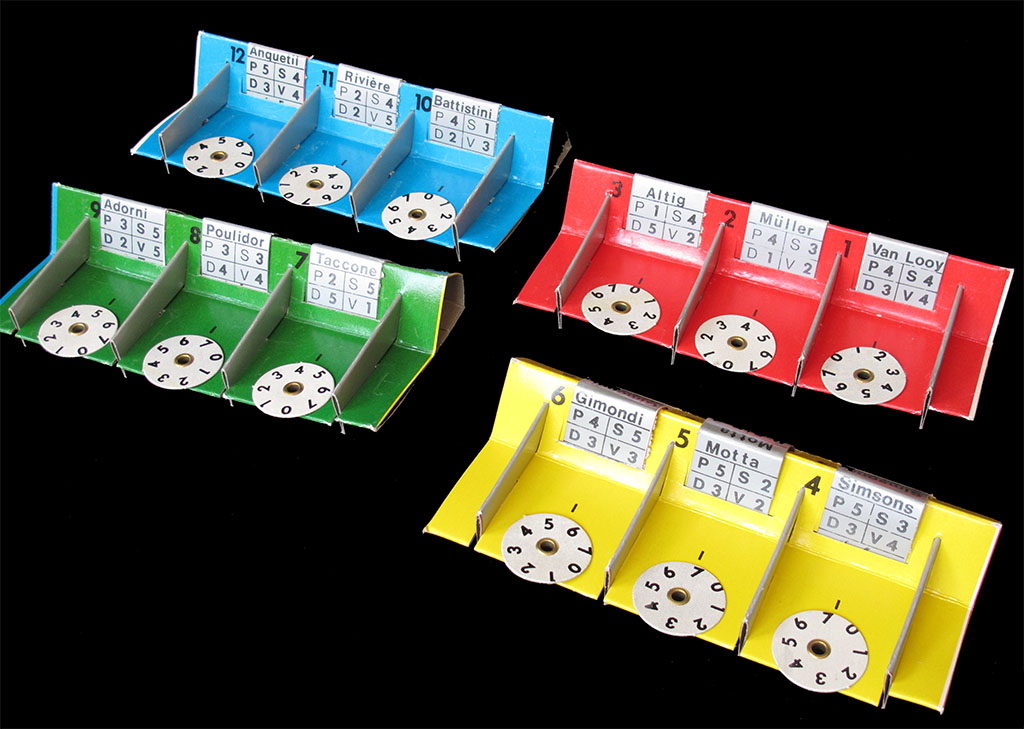
Since both boxes clearly state "Copyright 1966", this is the date I use for this game. However, if I were pressed, I would add that the copyright date (when there is one) is not necessarily the release date of a game, that some elements in the "giochi simulatori" box make me think that this version of the game could have been released before 1966, and that some of the same elements in the "Facis Giocs" box lead me to think that this one was probably released a little later.
The cyclists are quite small (29 mm)
The riders are another difference between the contents of the two boxes. The ones in the "giochi simulatori" box are not strictly monochrome; their bikes are painted, and the riders are better finished somewhat.
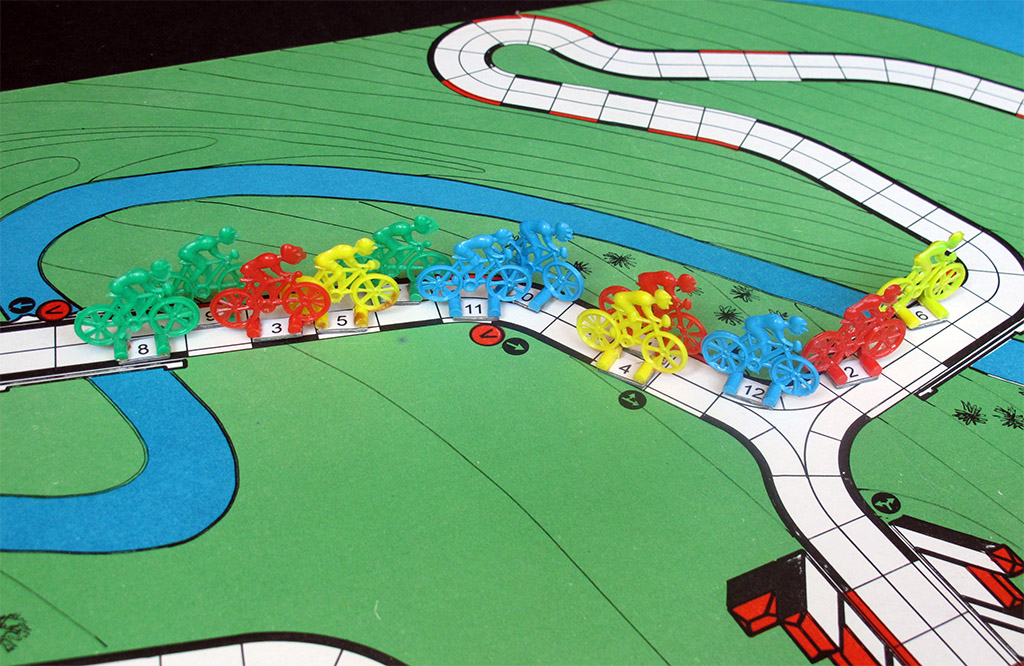
The monochrome riders look good too
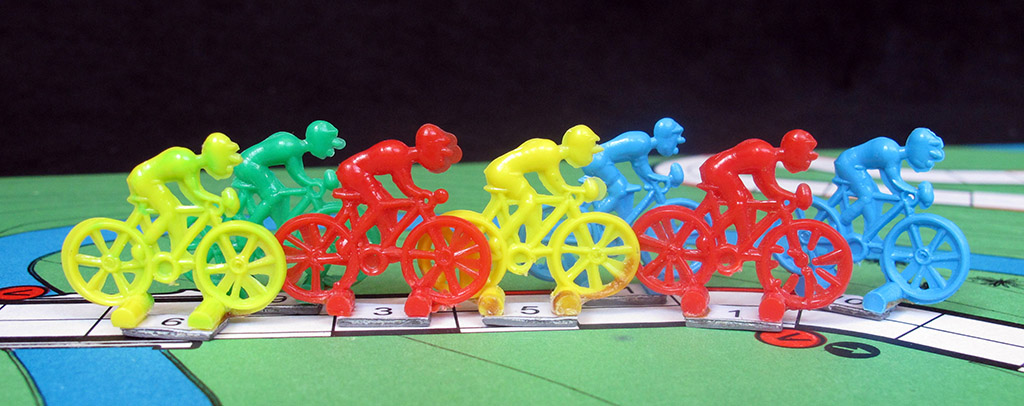
Don't they?
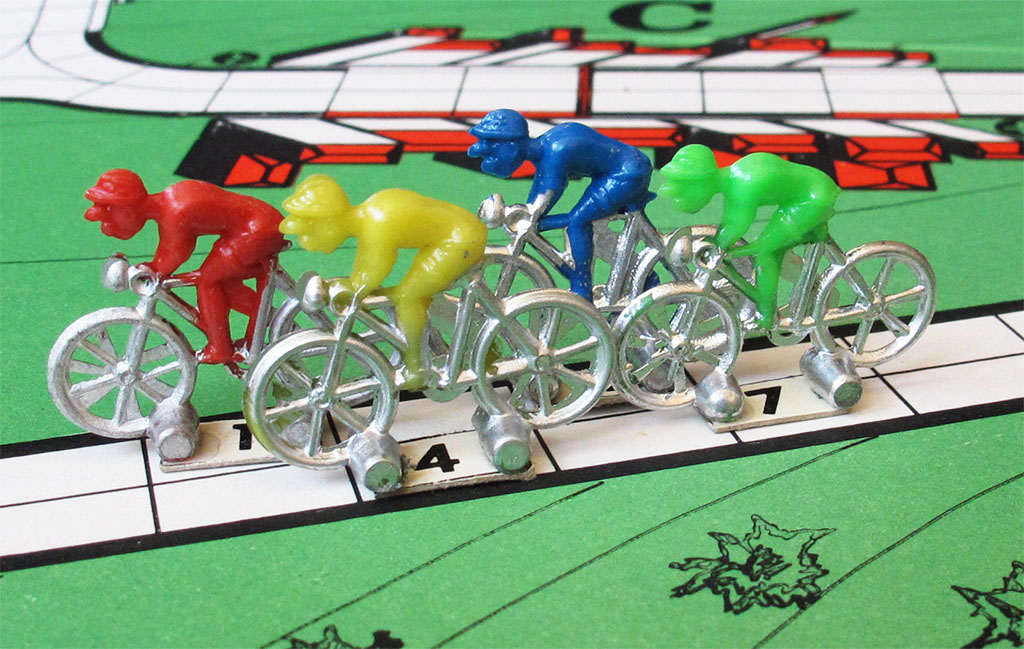
Which do you prefer?
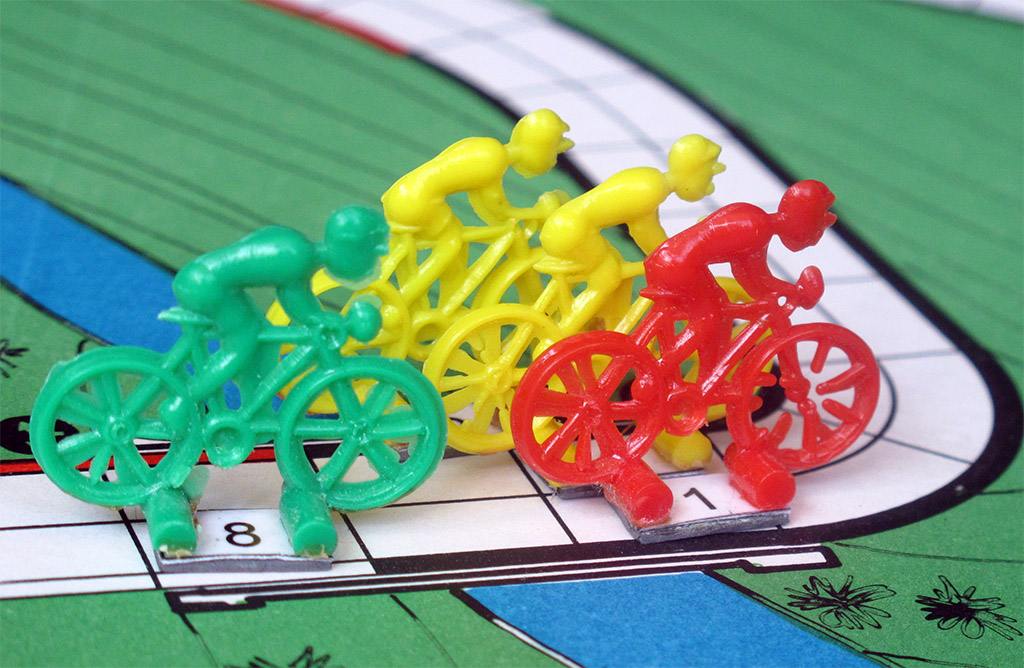
The faces of these monochrome riders are quite undefined
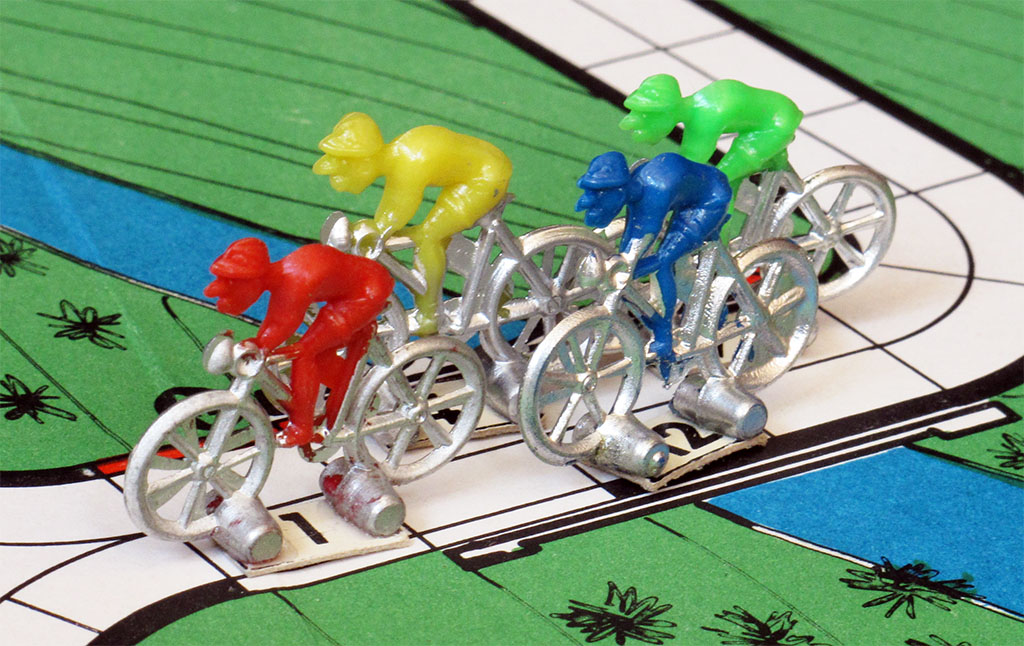
These are better defined, though in a 29 mm rider you need a magnifier (or a macro picture) to tell the difference
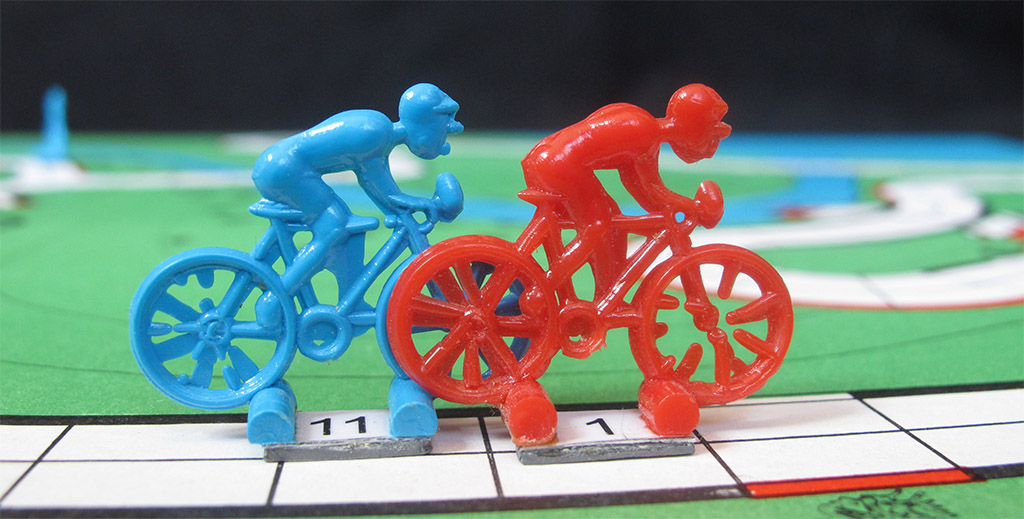
The plastic injection did not reach all the wheel spokes. However, although you appreciate it clearly in this picture, you do not really mind with 29 mm riders.
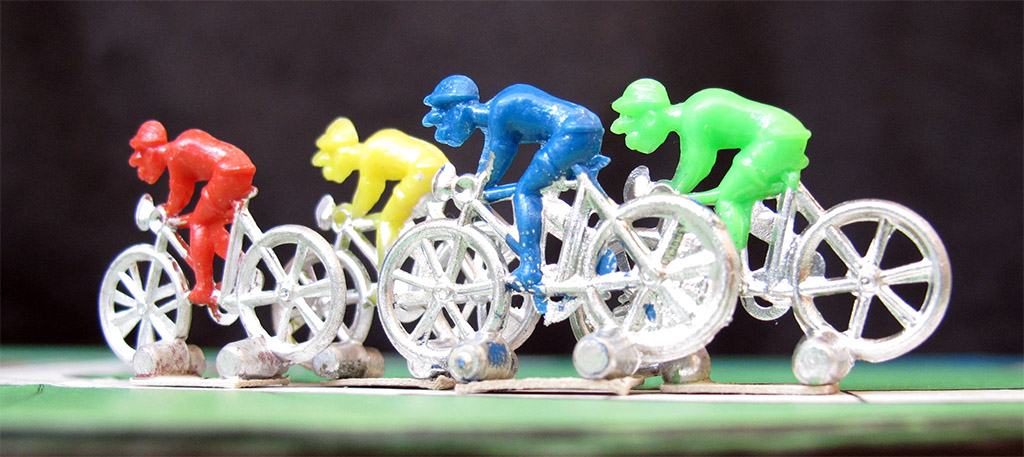
All the spokes here!
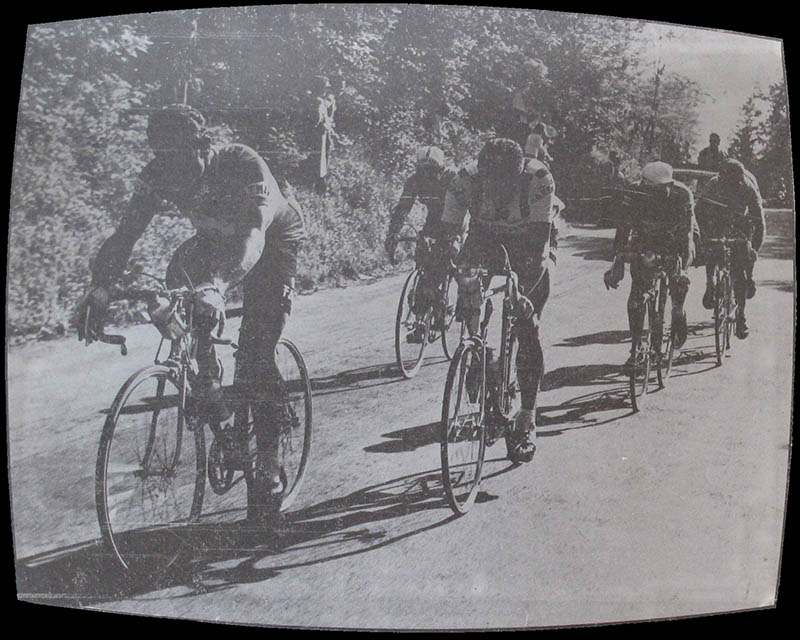
Of course, identifying the riders depicted on the box covers could help to date the game. At least it would provide a terminus post quem (a date before which the game cannot have been made). However, this black and white picture will hardly help to date the game, since it looks like it was taken well before 1966.
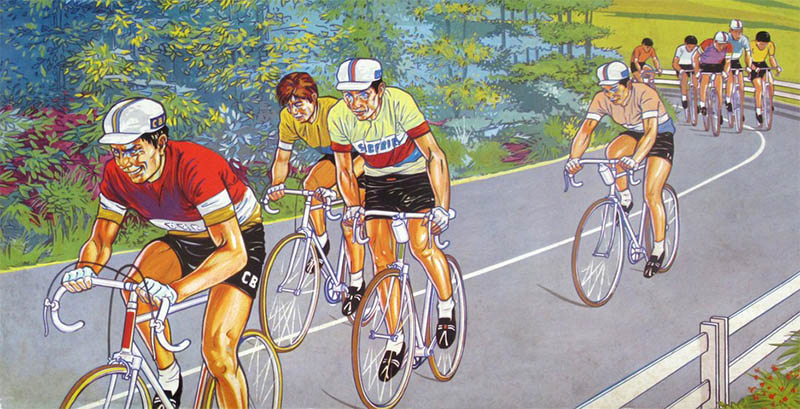
As well, I do not think that trying to identify these riders will help much, since any interpretation. However, who would you say they are? I am open to suggestions.
Description rewritten in April
2026.
|
|
|
|
|
|
|
CULTURE |
TOTUM REVOLUTUM |
NAMES |
CATEGORIES |
WHAT'S NEW |


