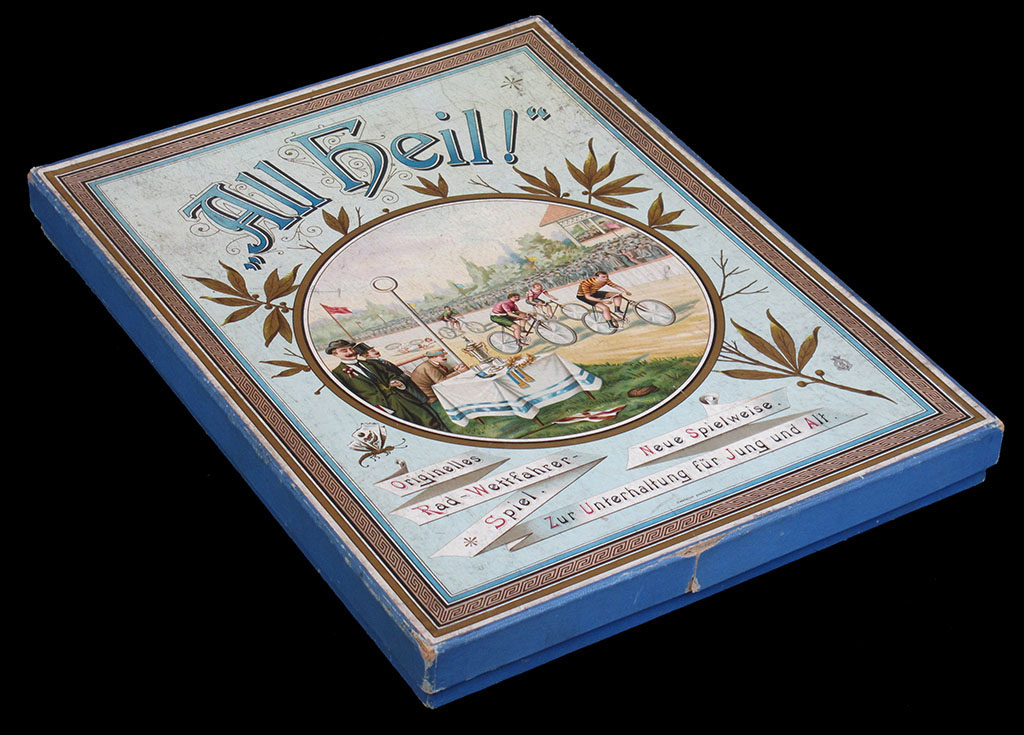
ALL HEIL!
Adolf Sala, Germany, 1899
Here is a fine turn-of-the-century German game from François Cardinet's collection. This game was made in Berlin by Adolf Sala. There are two versions of the game, of which this is the smaller one. It has a black cardboard spinner, while the bigger version uses an oversized cyclist. At first I was afraid that this cyclist might be missing, but after some thought I think it was not included in this version of the game. The rules (which say "Kleine Ausgabe") mention a spinner but not a spinning cyclist, and I do not think the bigger cyclist would fit in this box, which is quite flat (it measures 41 x 31 x 4 cm).
"All Heil!", as I already explained elsewhere, is (or used to be) the usual German greeting between cyclists. In the early years of German cycling sports, "All Heil" had also been used to greet the finishers of a race, which is possibly the intended meaning here.
There is also a French version of the game called "Jeu des Cyclistes. Nouveau Jeu Mécanique", by Mauclair-Dacier, of which there is only one version, as far as I know, and it has the oversized cyclist (scroll down to see it).
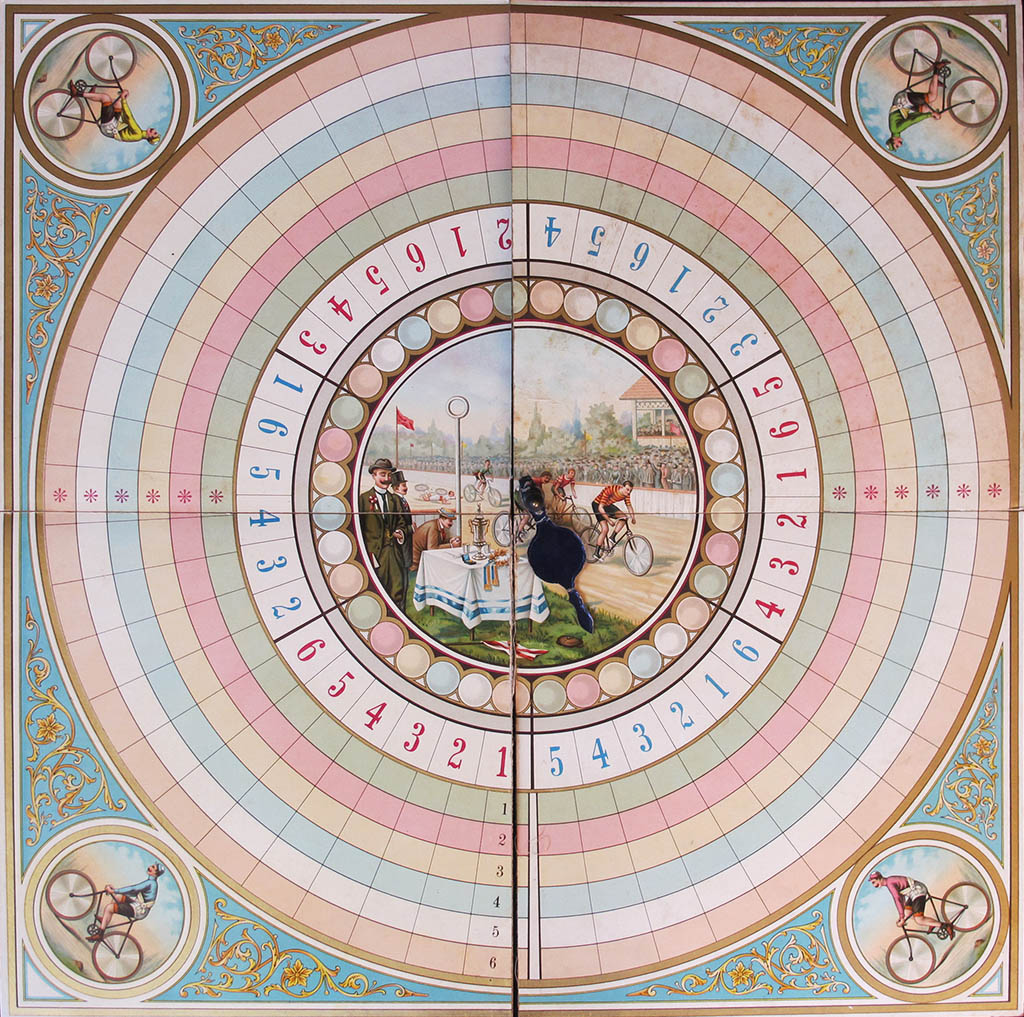
The board measures 61 x 61 cm and is divided into six lanes of different colours and a central spinning zone divided into six parts. Each of these parts has six different positions, with all six track colours and the numbers 1-6 represented in such a way that all 36 possible combinations are found somewhere.
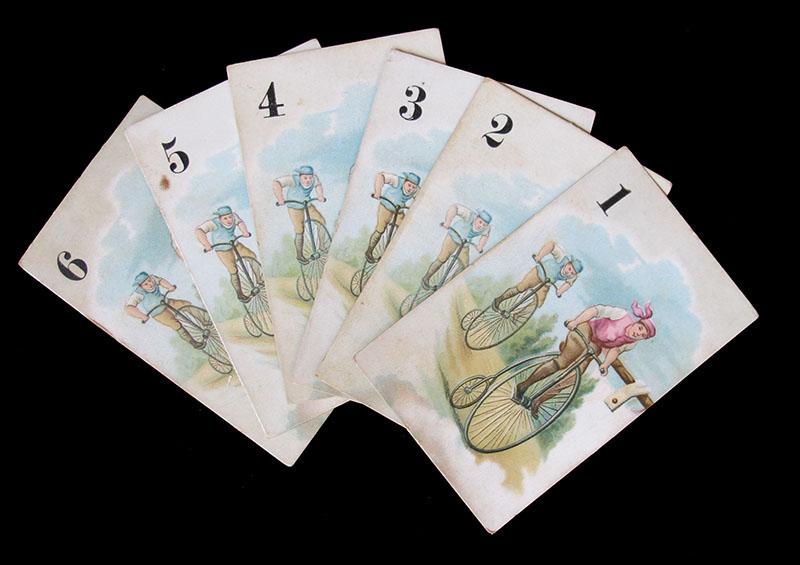
At the beginning of the game every player draws a card with a number from 1 to 6 which determines the order of play and also the placement of the riders at the beginning of the game. (I assume the movement is clockwise, as indicated by the riders on the corners of the board, but the rules only mention that the spinner must be spun clockwise. If they mention the cyclists, I have missed it).
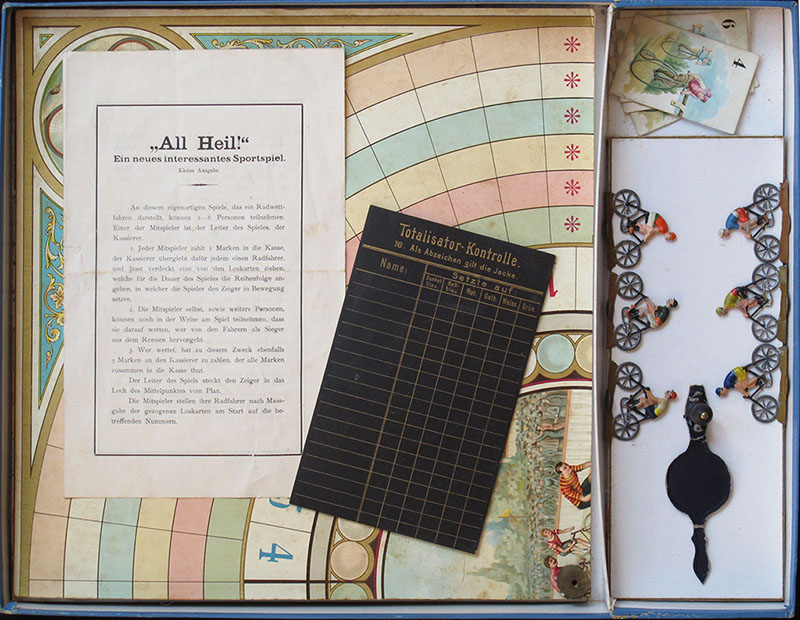
Contents of the box. The metal
cyclists are 40 mm long.
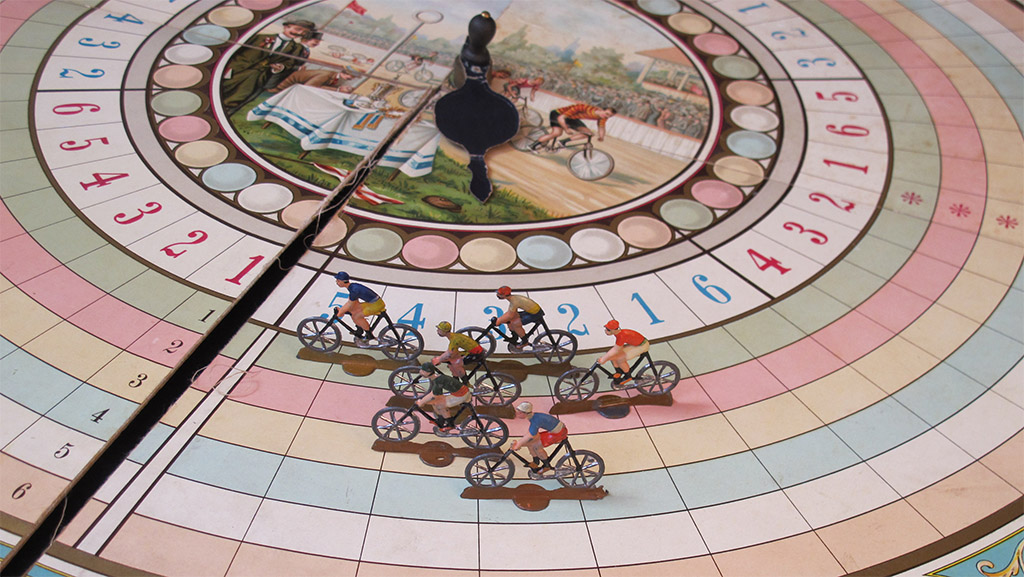
At first sight one might think that every spin marks which rider moves and how many squares he moves, as if the game was played with two dice, a standard D6 and a six-sided coloured die, but then the cyclists should be of the same colour as the lanes, shouldn't they? They are not, and there is a little more to the game than that.
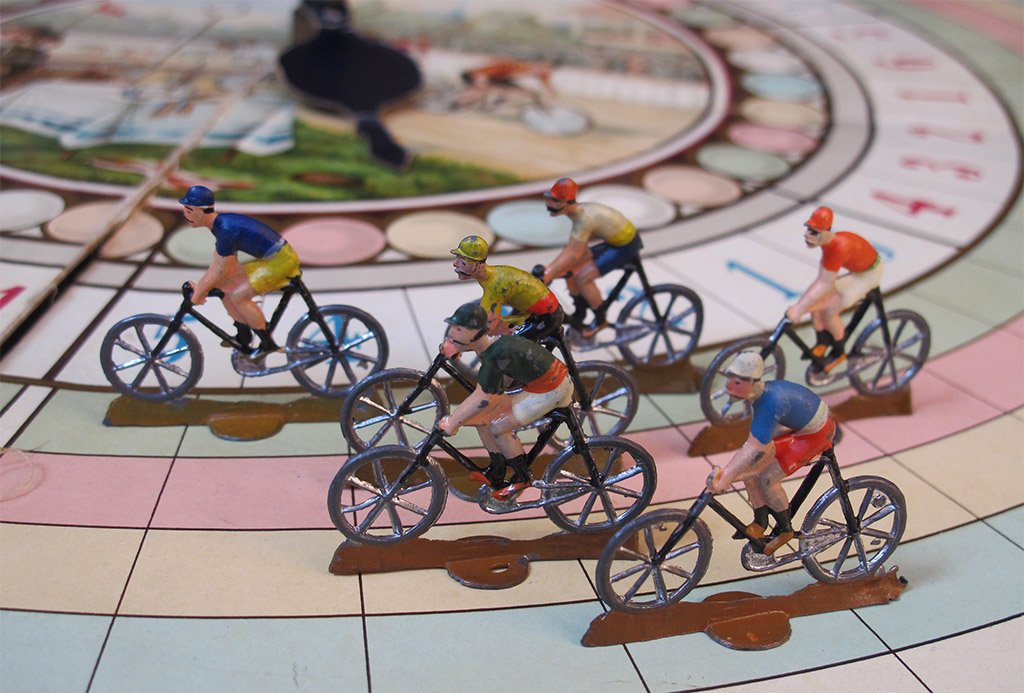
When a player spins, all the values in the sixth of the board on which the spinner lands are taken into account. Let's say the first player spins a 4/blue, which is on the second sixth of the board. On the same section we have 1/green, 6/pink, 5/yellow, 3/white, and 2/brown. In that case, the player that has spun moves his rider to the blue lane (laterally) and moves forward four spaces. Then all the rest of the riders move the number of spaces indicated by the colour of the lane they are on: any rider on the green lane moves one square, etc.
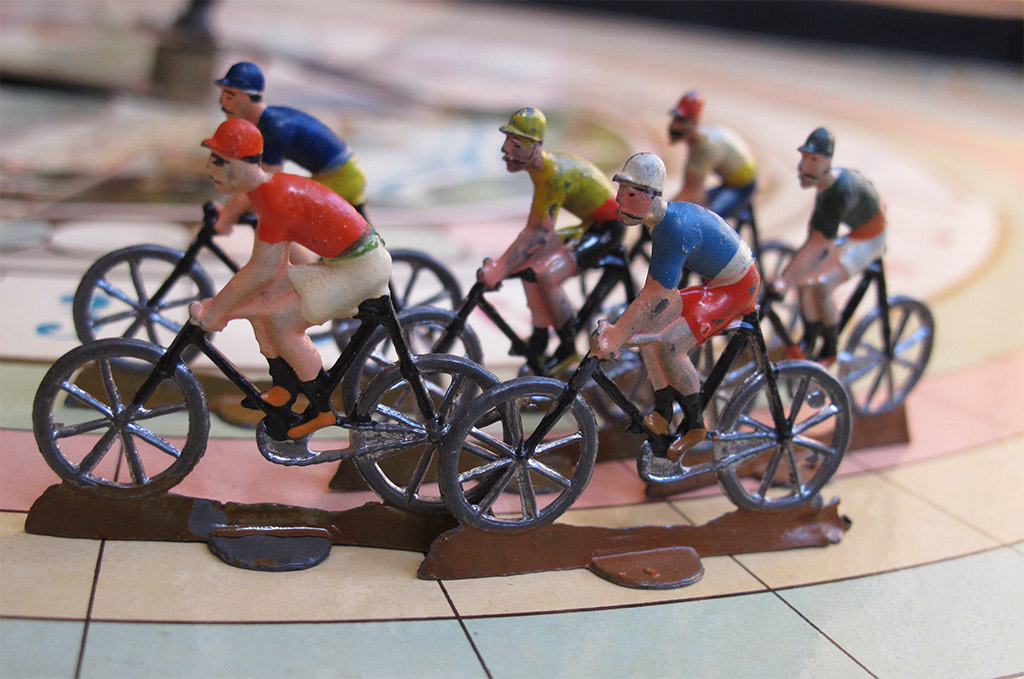
The rider who has spun is not blocked by another rider in his lane; he may move past that rider (however, the rules do not say what happens if he lands on the same space). On the other hand, any other rider that finds his way blocked by a rider will stop his movement on the square behind that rider, even if he has enough points to go further.
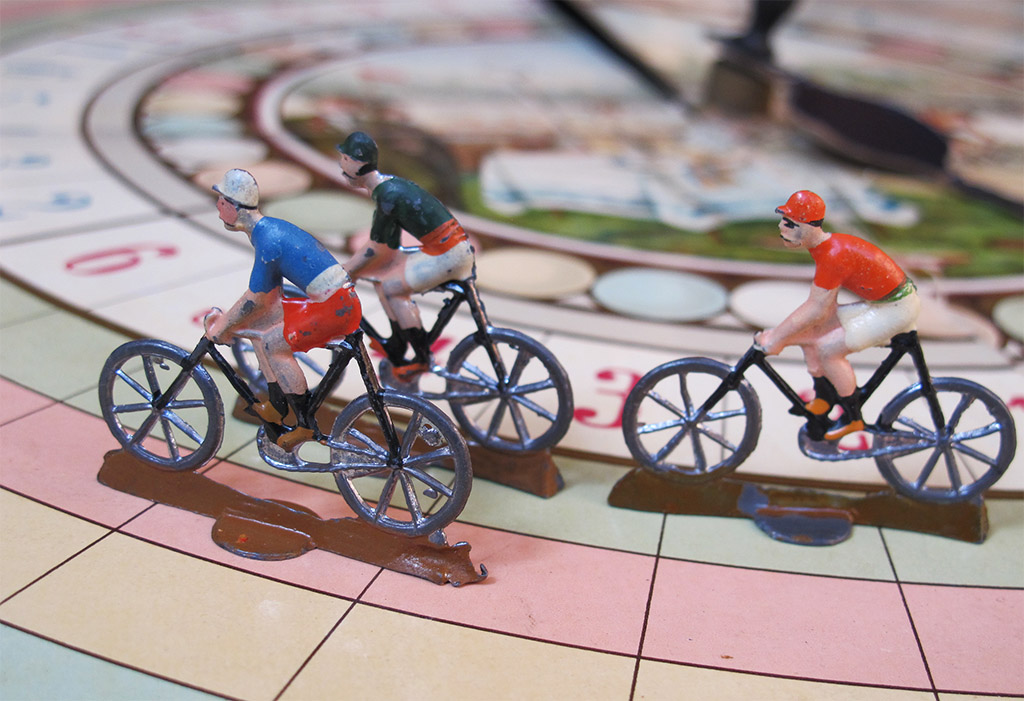
If a rider spins the colour of the lane he already is in, he does not change lanes and he moves forward 10 spaces (instead of the number spun).
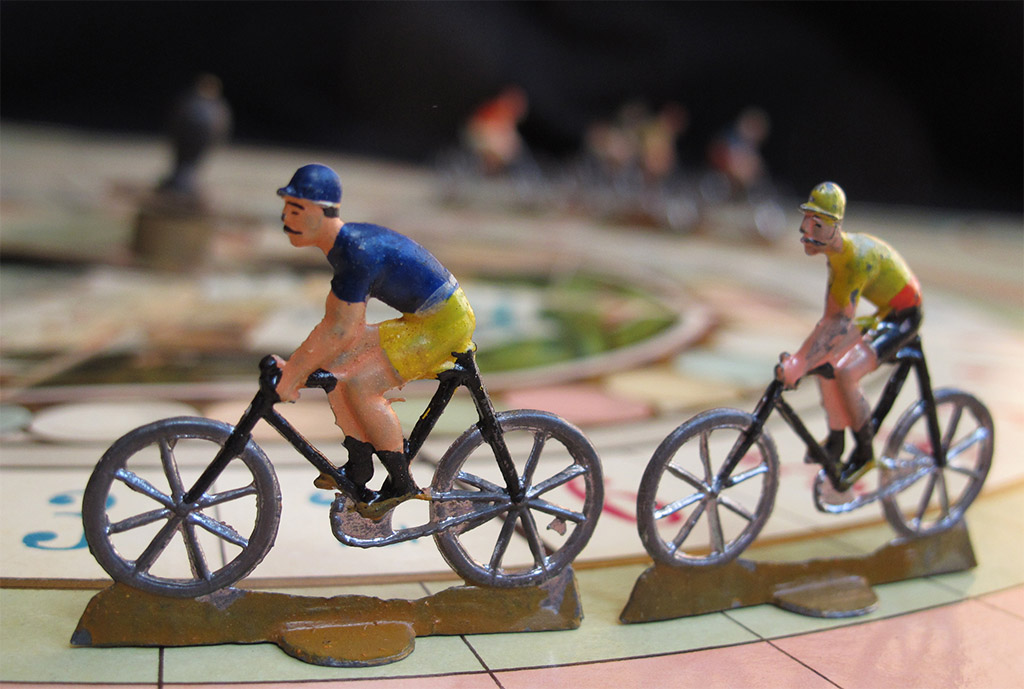
Finally, if a rider lands on a space marked with a star, he has fallen and does not move in the next turn. While this is crystal clear in the French rules, when I first read the German rules I did not understand if they meant that the player would not spin the next time he should have, in a kind of improbable delayed fall that made sense (at least in my head) since the player who spins has an advantage. In the end, I do not think there is any ground for that in the rules; it's just that my French is much better than my German.
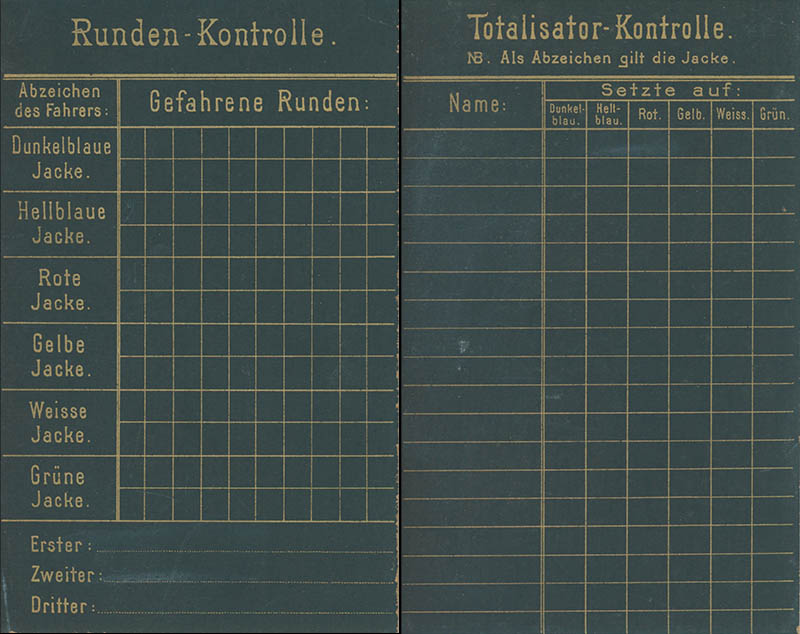
The race can be run over one lap or more. A "Runden-Kontrolle" blackboard is provided to keep track of the laps. On the other side there is a "Totalisator-Kontrolle" in which players will keep track of the bets, since this is a betting game.
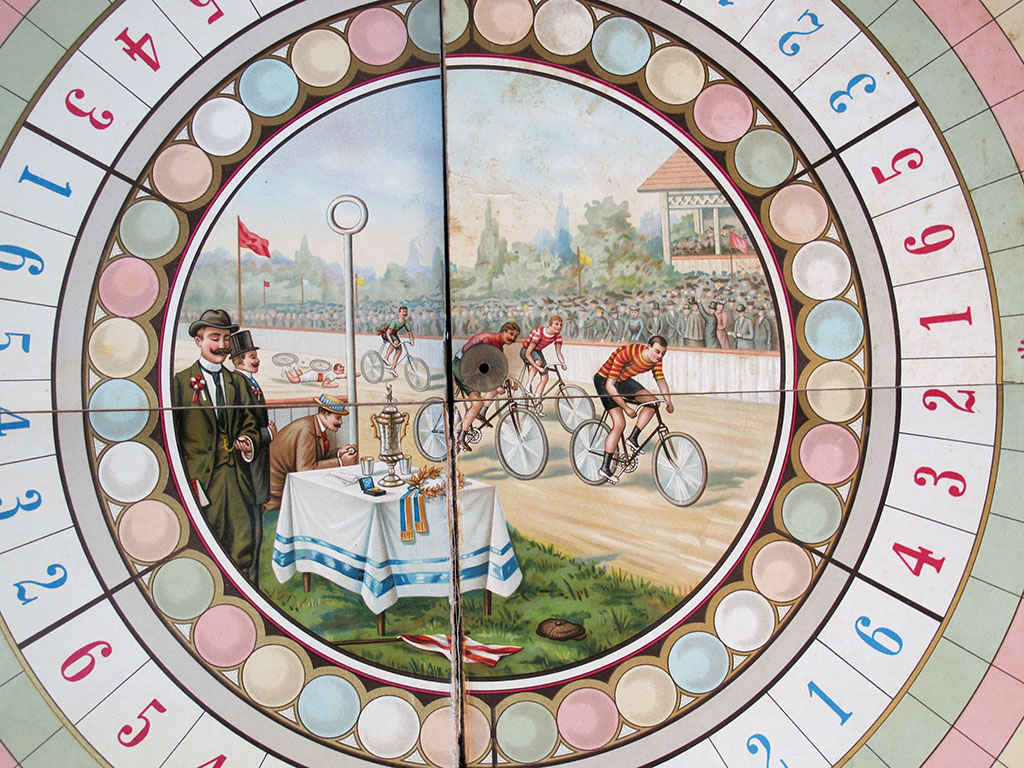
Even if it does not feature an oval track, I have no doubt that this game represents a track cycling race. If you do not agree, just have a look at the illustration on the box and in the centre of the board. Of course, cycling tracks were different back then.
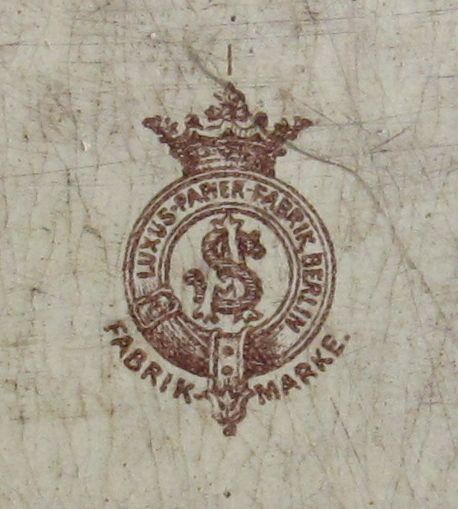
Siegfried L has sent some interesting information about this game. He informs that the small logo on the lower right part of the box lid shows the initials of "Adolf Sala Luxus-Papier-Fabrik, Berlin" ("luxury paper factory", which later changed to "Sala Rotsiegel Spiele"), once one of the big German game-maker names. The history of Sala is well documented; there are two extensive Wikipedia pages that provide a lot of information (as long as you read German): (a) a detailed history of the company, and (b) a ludography, according to which the release date of "All Heil!" was 1899.
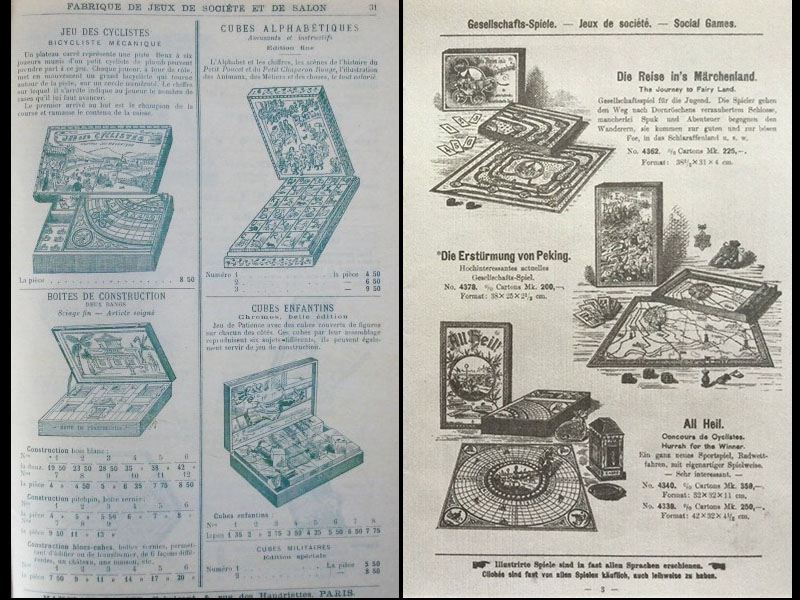
On Alain Rabussier's invaluable website we find a couple of catalogues featuring this game: Mauclair-Dacier's (p. 31, left) and Adolf Sala's (p. 3, right). In Sala's catalogue we can see the two versions of the game: the cheapest one, selling for Mk 2.50 (*), measures 42 x 2 x 4.5 cm (for sure, the one I have); and another that costs 3.50 Mk and measures 32 x 32 x 11 cm. We also see that there is an English translation of the game's title, "Hurrah for the Winner", and that it is transtlated to French as "Concours de Cyclistes". I have never seen an English version of the game, or a French version with that title. If you have, please let me know.
(*) The prices I read on the catalogue are Mk 250 and Mk 350, but they look quite high (you could buy a good bicycle for that price in 1899), unless I have misunderstood it and these are prices for boxes ("Cartons"?) of games. But then, I can't see how many games were supposed to be in the boxes.
Siegfried L. informs us that the "%" sign means that these are wholesale prices, not final customer prices, which were undoubtedly higher, and that this game was quite expensive (though not the most expensive in Sala's catalogue), surely a luxury item, as one could have expected of a "luxury paper factory".
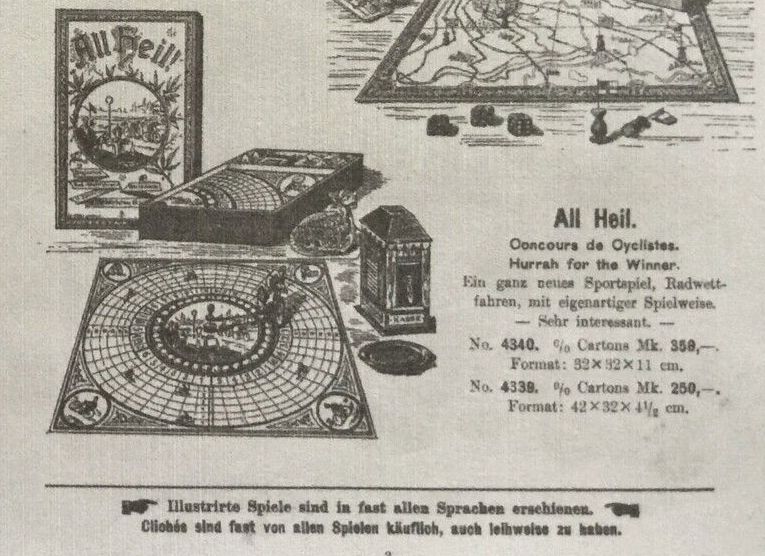
Siegfried adds that the little building marked "Kasse" (cash desk) seen at the right of the board is the telltale mark of a betting game.
The catalogue describes the game as having an "eigenartiger Spielweise", a peculiar playing style, and that it is "ganz neu", completely new. While I would not fully trust this last statement, since catalogues are expected to say that all is new, Siegfried thinks that the game is originally German and that the French version is a rebranding. He may have a point (the two German versions, the Kasse building...), but I cannot ascertain it.
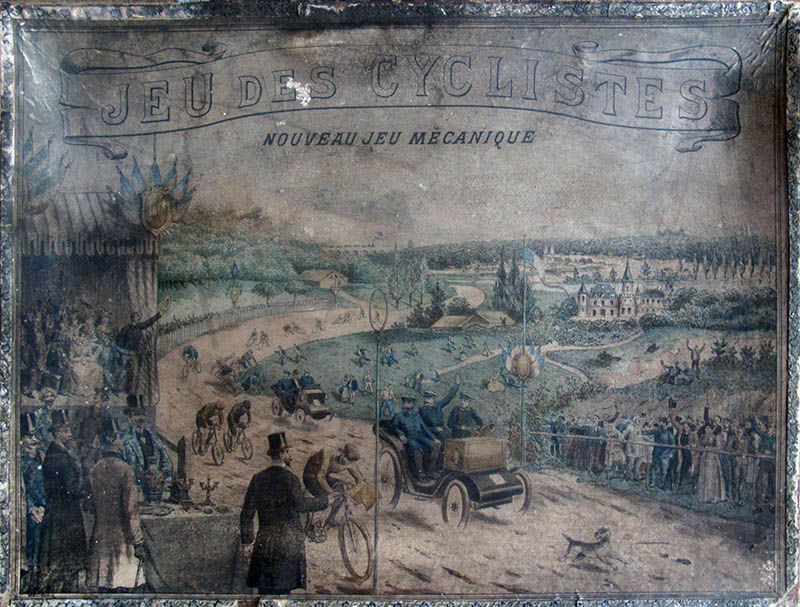
Box lid of the French version of the game in Marc
Radenac's collection.
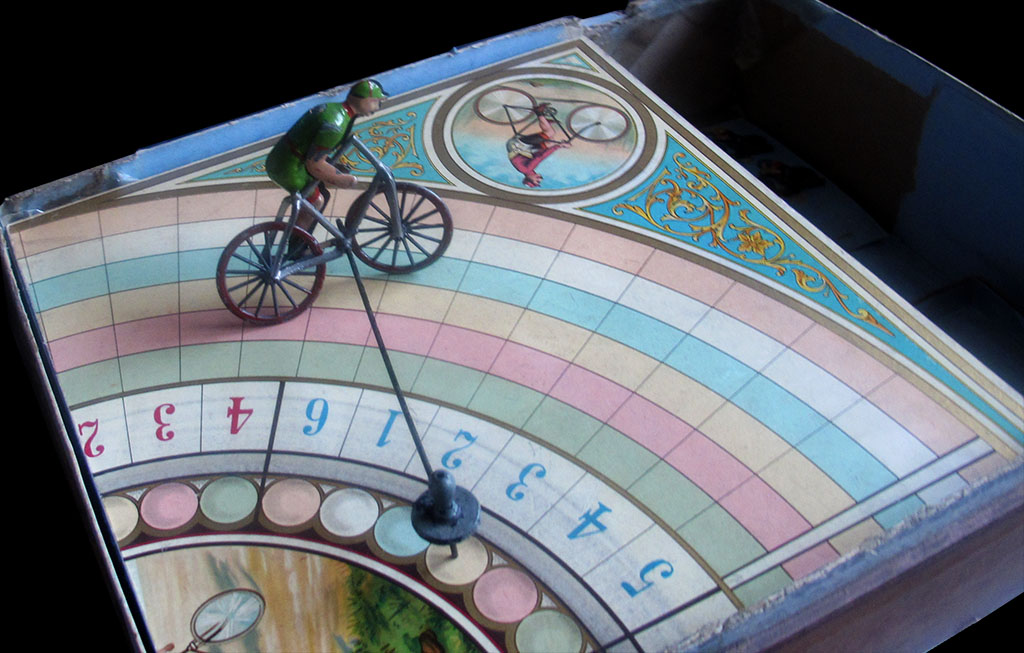
Contents of the French version of the game, including the "mechanical" big cyclist (misplaced in this picture, of course; my fault).
Thanks, Siegfried, for your invaluable
investigation.
Thanks, Marc (and Maryse), for inviting us to visit you and your collection.
Thanks, Mathilde, for gifting me your
father's collection of cycling games.
Description written in April
2026.
 |
 |
 |
 |
 |
|
CULTURE IDEAS |
TOTUM REVOLUTUM THUMBNAILS |
NAMES ALPHABETICAL |
CATEGORIES LISTS |
WHAT'S NEW BLOG |