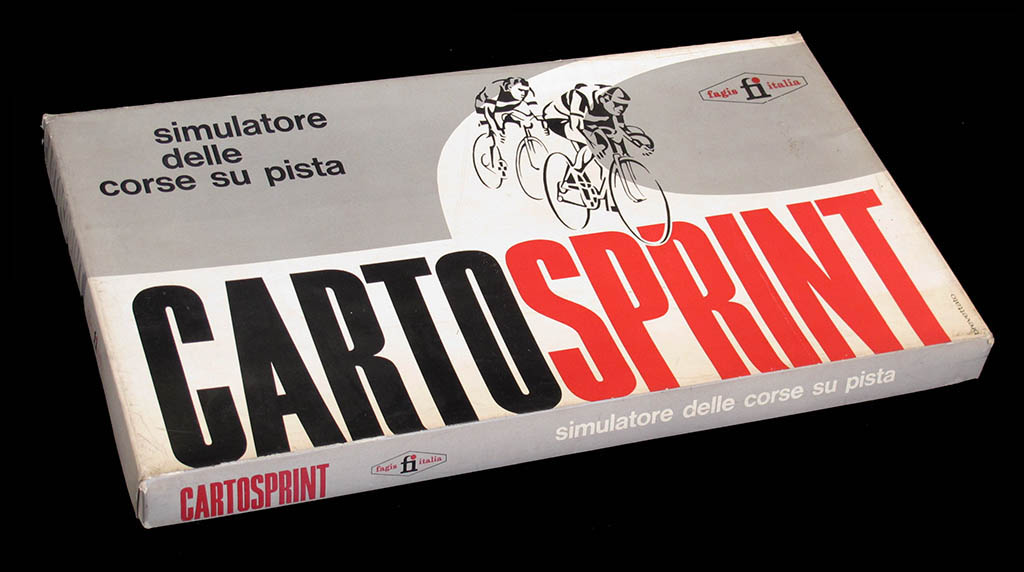
CARTOSPRINT
Fagis Giocs, Italy, 1967
Here is a fine Italian track-cycling game featuring a celluloid 3D board with canted curves (and even straights). While 3D boards can be a bad idea, since cycling figurines are known for not being particularly stable and tend to fall if inclined, this is not the case in this game; the riders stand perfectly on the board. On the other hand, the celluloid board has proven not to be the better option from a long-term preservation perspective. All the copies of this game I have seen are broken. Fortunately, most (including mine, which used to be in François Cardinet's collection) are still playable.
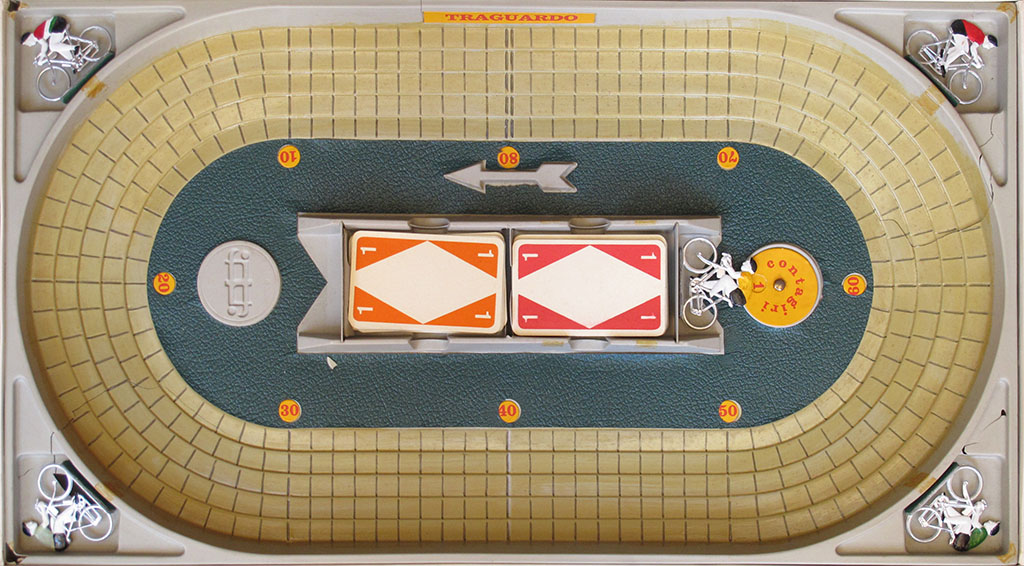
This board is obviously not foldable. The box is thus compulsorily big: in this case it measures 60 x 33 x 4 cm. The riders are big too (55 mm long). Oddly, there are five riders (as well as five lanes in the track) but only four spots to put them in the box. The fifth rider is left on the pelouse.
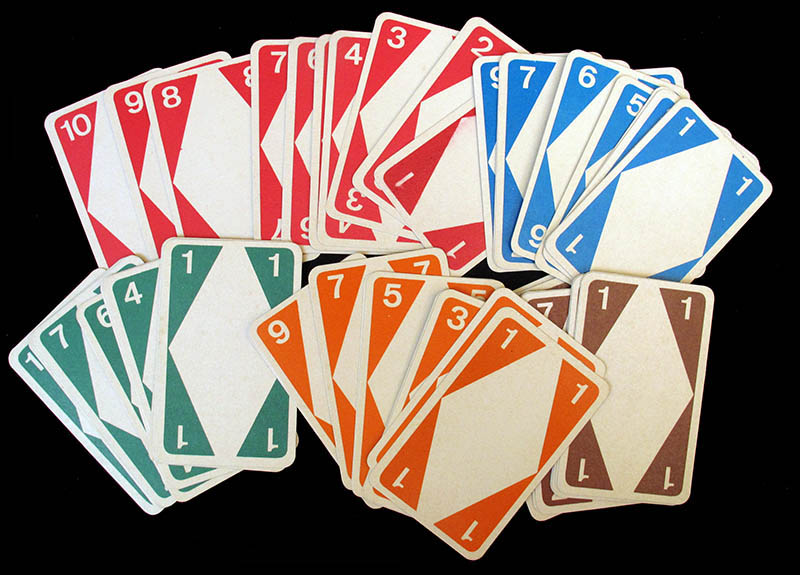
The movement of the riders is controlled by cards. There are 50 cards in the game, five of each number from 1 to 10, in different colours. Five cards are dealt to each player, and the rest are placed in two face-up decks of roughly the same size in the middle of the board. In his turn a player can either (a) play a card under a deck if the top card is of the same colour, move the number of spaces shown on the played card, and take the uppermost card of the other deck; (b) play a card under a deck if the top card is of a different colour, or play a card over any deck regardless of the colour of the cards, and move three squares without taking a card back; or (c) if he has less than five cards in his hands, a player can take the uppermost card of one of the decks but does not move in that turn.
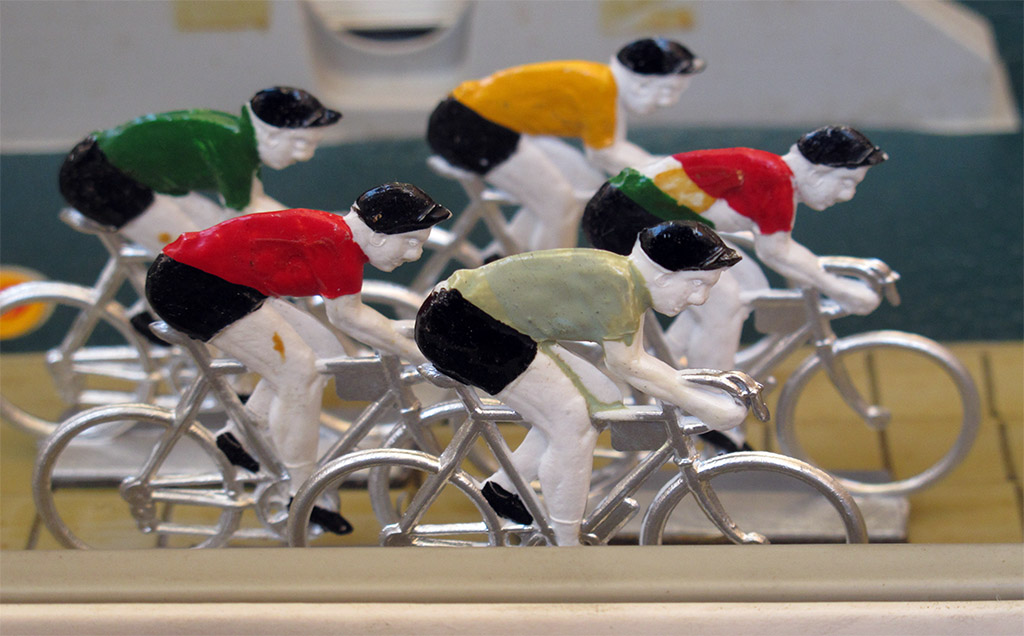
The game turn is in the order of the race: Riders placed ahead move first; in equality, riders on the outer lane move first. There is an aspiration rule: a rider placed directly behind another in the same lane benefits from aspiration. When the rider ahead advances a certain number of spaces, the rider behind adds half that number to his movement.
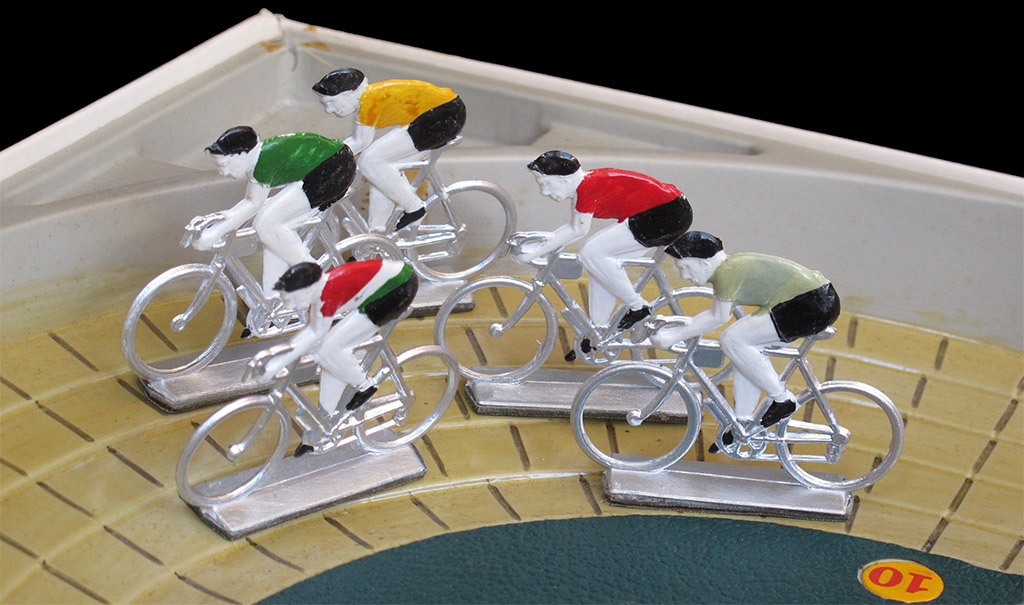
As you can see, each rider stands on three squares. A rider placed "immediately behind" another is, in fact, four spaces behind in the 80-space-long track. In case you wonder, you cannot move through spaces occupied by another rider.
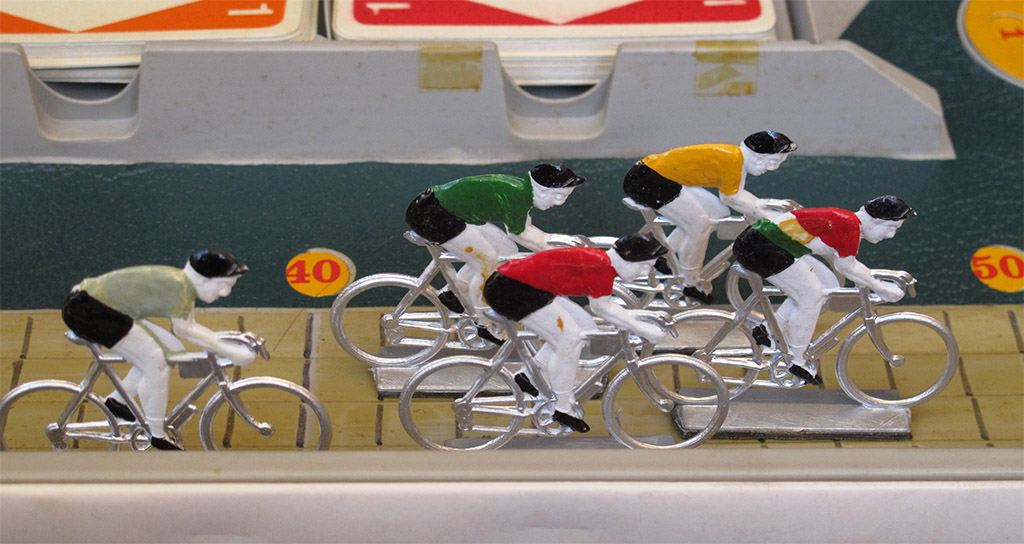
The banking of the track also plays a part in the game. Besides the fact that riders on the outer (higher) lane move first, a rider may move down diagonally one space at no cost. However, moving up to an outer lane costs one movement point, and that movement is lateral (not advancing one space).
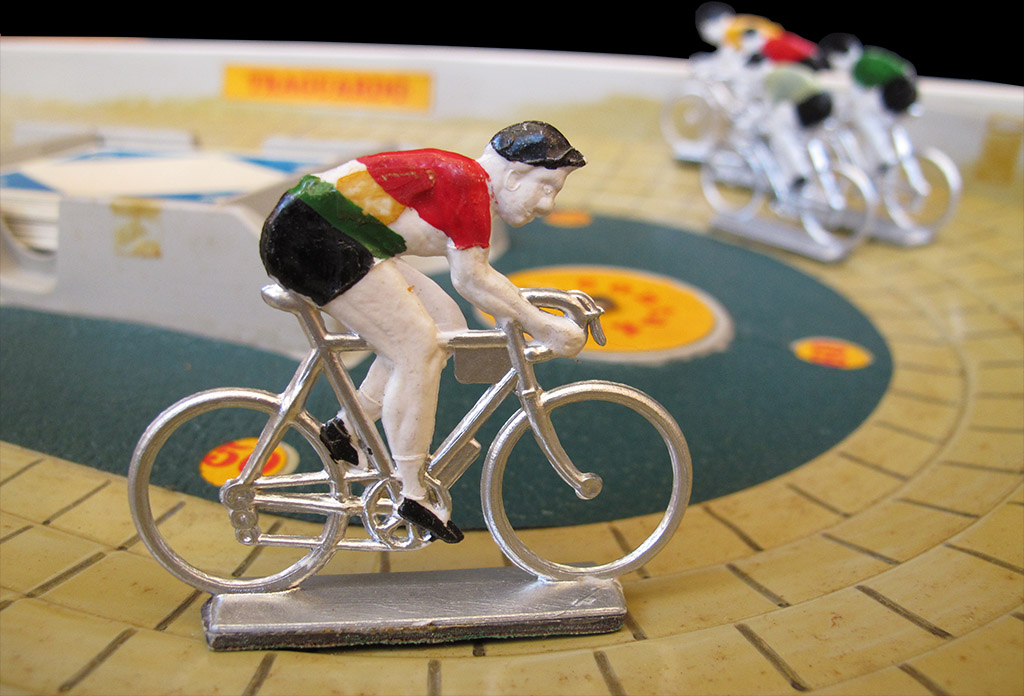
The winner of the race is decided on a further-past-the-post basis after all players have completed the turn. In case of equality, the rider on the outer lane is considered to be ahead.
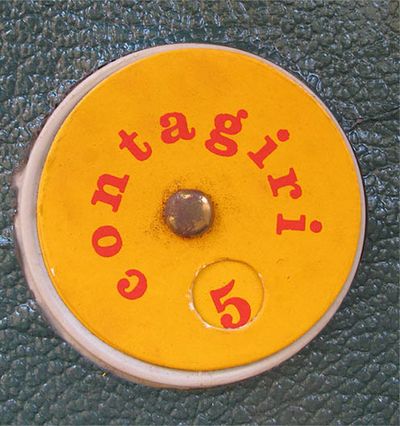
The rules mention the possibility of playing three different races: two-lap sprint, elimination, or five-lap points race. A lap counter is provided.
All in all, this is one of my favourite track-cycling games.

Logo on the game's box

Logo on the last page of the rules
A note on the maker of this game: There is another game, Ciclorama, found in two different boxes, the first attributed to "Giocs. Giochi simulatori" and the second to "Facis Giocs". On one of the boxes you can read "Il simulatore delle corse ciclistiche su strada" (simulator of road cycling races). In this game, made by "Facis Italia", you read "Simulatore delle corse su pista". Too many coincidences to even suppose that they were not made by the same maker, especially when on the last page of the Cartosprint rules we can see that "Fagis" stands for "FAbrica GIochi Scientifichi", something well suited to games self-described as "simulatore".
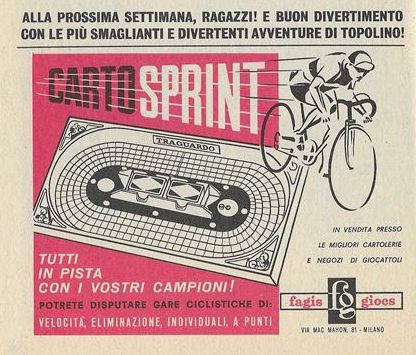
To settle the matter, my friend Roberto Letizia (thanks!) has found this ad, which appeared in Topolino nş 625, November 19th, 1967, where you can see the "Facis Giocs" logo. (The Milano address has changed, though). This ad is also what has helped me date the game.
Thanks, Mathilde, for gifting me your father's copy of this game.
Description written in April
2026.
 |
 |
 |
 |
 |
|
CULTURE IDEAS |
TOTUM REVOLUTUM THUMBNAILS |
NAMES ALPHABETICAL |
CATEGORIES LISTS |
WHAT'S NEW BLOG |