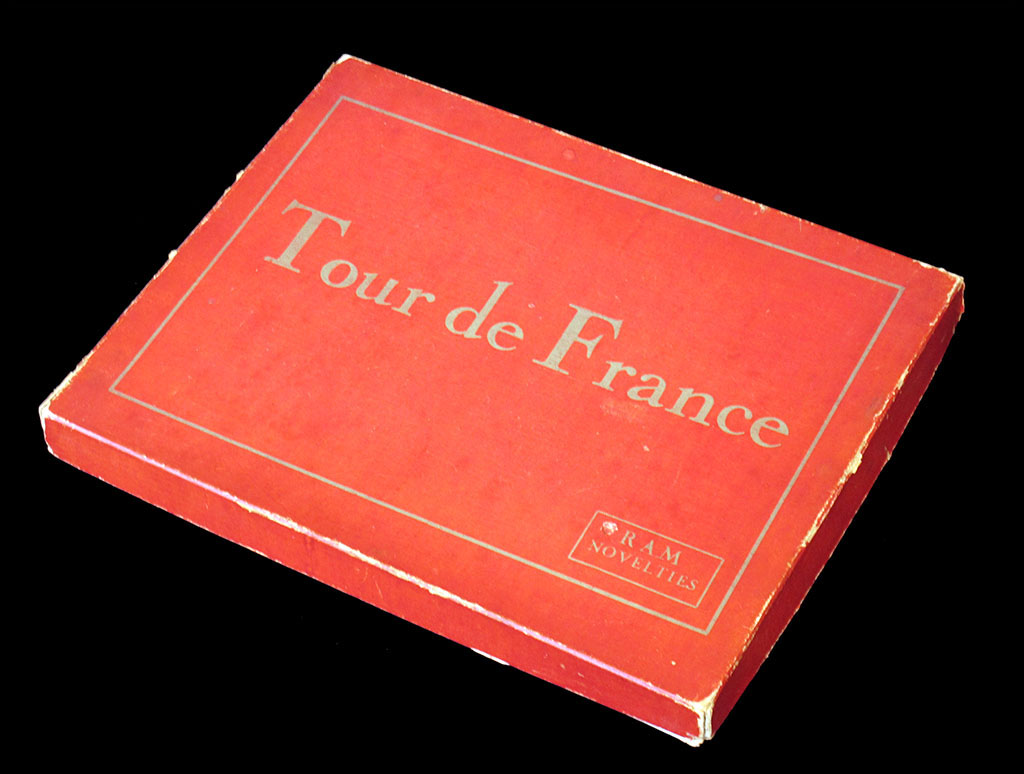
TOUR DE FRANCE
RAM Novelties, Belgium, 1935
This rare vintage Belgian game from François Cardinet's collection. Were it not for the small inscription "Made in Belgium" on the lower right corner of the board, one could think at first sight that this is a French game, since the rules, as well as the title of the game inscribed on the board, are in French only (no sign of Flemish, but that may probably not come as a surprise to older Belgians, does it?). By the way, the title of the game on the board is different from the one on the box. I have chosen to use the latter as the name of the game, though that is debatable.
Another reason why one could mistakenly think that this game is French is that all the rest of the (known) Tour-de-France-specific games prior to World War II are. (There is this 1941 Dutch game that could almost be an exception; I have to research and rewrite that game's description someday). The fact that I have been unable to find more information about the makers of this game, "RAM Novelties", does not help either, though the simple fact that it is not called "Nouveautés RAM" should have made me suspicious.
Another telling clue is the fact that the Belgian team is mentioned first in the rules, before the French team. No French game maker would ever consider that option!
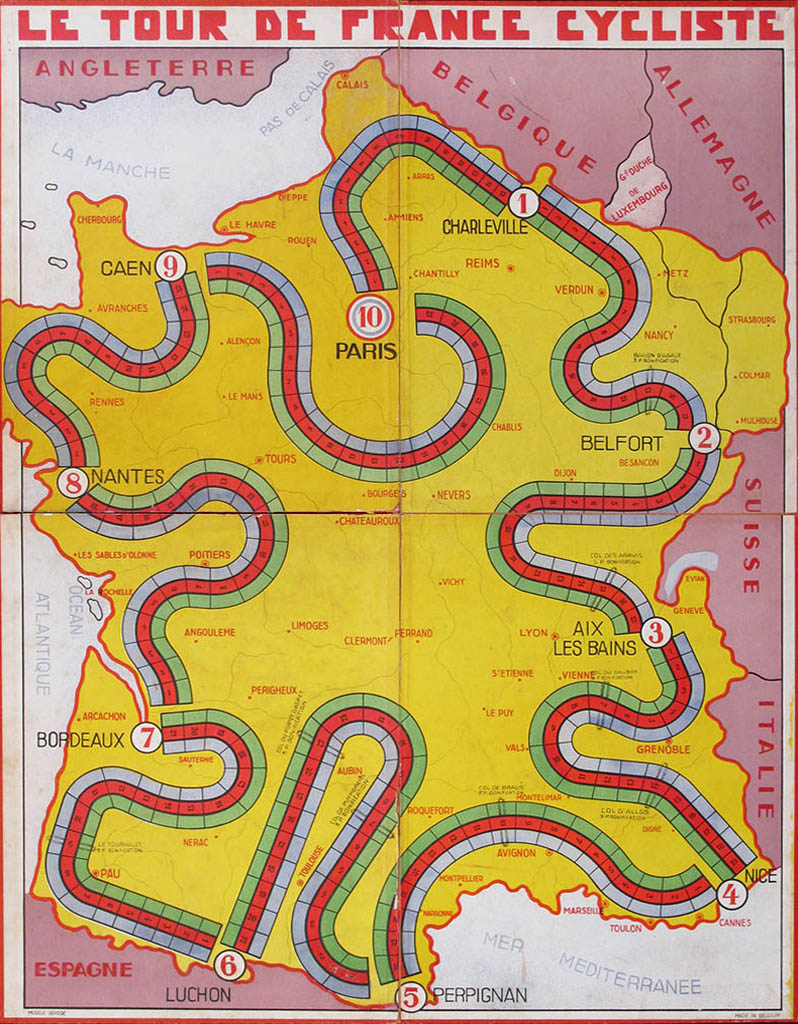
Big board (72 x 56 cm;
four-folded in a 38 x 29 x 3.5 cm box)
The game board displays a 10-stage Tour de France. While the 1930s Tours had many more stages than that (some editions had almost 30, counting the split stages), all the cities represented in this map were start and/or finish stages, in the same clockwise order, of the Tours of 1932, 1934, and 1935. Since my theory (amply applied in my reviews of other games on this site) is that it cannot be a coincidence and that therefore if a game matches the stages of a certain edition of a Tour it has to be made after this Tour (or at least after the stages of that Tour were made public), considering the board only, it would be safe to say that this game was made after 1932.
However, there is another relevant piece of information in the rules of this game. The four teams in this game are Belgium, France, Italy, and Spain. This is important since Spain had not sent a full team to the Tour de France since 1930 and did not send one again until 1935. Not only that, but all 16 cyclists mentioned in the rules took part in the 1935 Tour de France (not so in other editions of the Tour: there were only 14 of them on the 1934 Tour, for instance). Furthermore, except for the riders in the Spanish team, all the other cyclists mentioned in the rules had a relevant role in the 1935 Tour de France. The three members of the Italian team, Francesco Camusso (misspelt "Camuso" in the game rules), Ambrogio Morelli, and Vasco Bergamaschi, won at least a stage (Morelli won 2, actually, and finished second overall); Georges Speicher and René Le Grevès, from the French team, also won stages (Le Grevès won 3), while the third French rider in the game, Antonin Magne (winner of the 1931 and 1934 Tours), was compelled to abandon the race after he was hit by a motorist when he was the biggest threat to the race leader and eventual winner, the Belgian Romain Maes.
Speaking of whom, we see that the Belgian team in this game is formed by "Aerts, Verbaecke, Maes". As a curiosity, it should be noted that these could even be four cyclists: while there is no doubt about Felicien Verbaecke (3rd overall and winner of the KOM classification in 1935) or Jean Aerts (winner of 4 stages), "Maes" could be either Sylvère (winner of a stage in the 1935 Tour, 4th overall, and, later, winner of the 1936 and 1939 Tours) or Romain (winner of the 1935 Tour de France, as well as of 3 stages, and one of the few riders to have won the Tour de France wearing the yellow jersey from the first day to the last). Though it is quite obvious to me that the "Maes" in this game is Romain (Sylvère was not even part of the Belgian team in 1935; he rode as an "individual"), players could choose between the two (unrelated) champions, especially if they played the game in the following years.
This leaves us with the issue of the Spanish team. Only five nations presented a complete team for the 1935 Tour, the fifth being Germany. Neither Spain nor Germany had a good performance that year. I cannot tell if the game maker's choice was due to personal, even political, reasons or if they just thought that the Spanish riders were stronger. Although my German friends might not agree, I think this is the most probable case. Vicente Trueba was the first KOM classification winner ever (in 1933, when that classification was introduced in the race), making him a lifelong Tour legend; Federico Ezquerra was a strong rider who would eventually win a Tour stage in 1936; Mariano Cañardo had already been 9th overall in the 1934 Tour and would also eventually win a stage in 1937, as well as being 6th overall in 1936. Incidentally, Cañardo, seven times winner of the Volta a Catalunya, is (or, rather, used to be) a local myth in my hometown; his legs were said to be so strong that even a football kick was named after him. His inclusion in this game automatically places it in my favourite games list.
With everything said above, I think it is perfectly safe to say that this game was not made before the end of the 1935 Tour de France. I do not see any reason why it should have been made much later since the stages do not match those of the 1936 Tour (most of them do, but Nantes does not), and of course the list of riders would have changed had the game been made later. So I stick to the date of 1935: I think this game made a fantastic Christmas gift for Belgian kids that year.
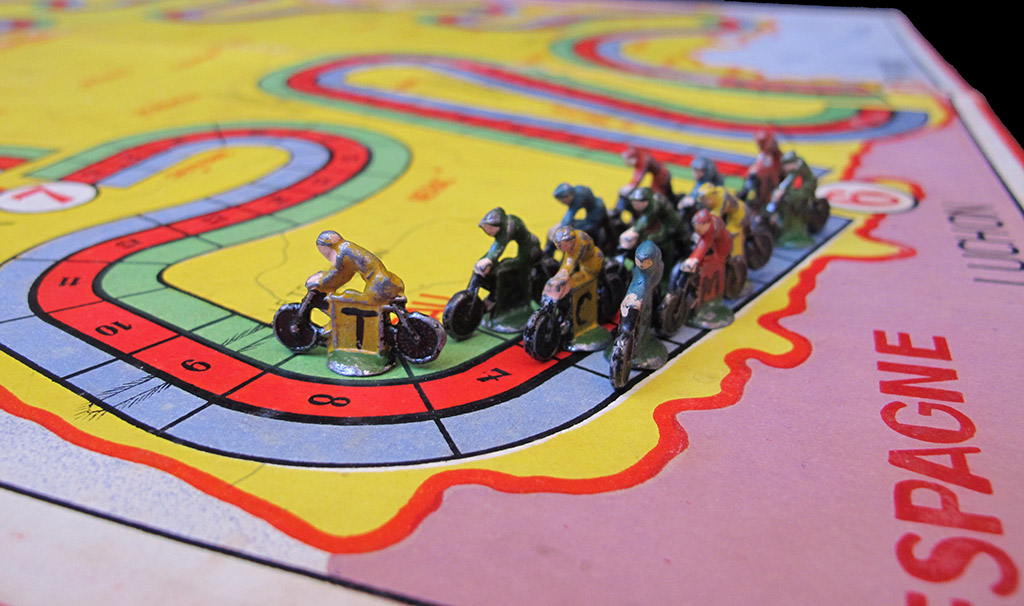
The lead riders are 23 mm long and have the rider's
initial to identify them. On the picture above, Vivente Trueba leads the race.
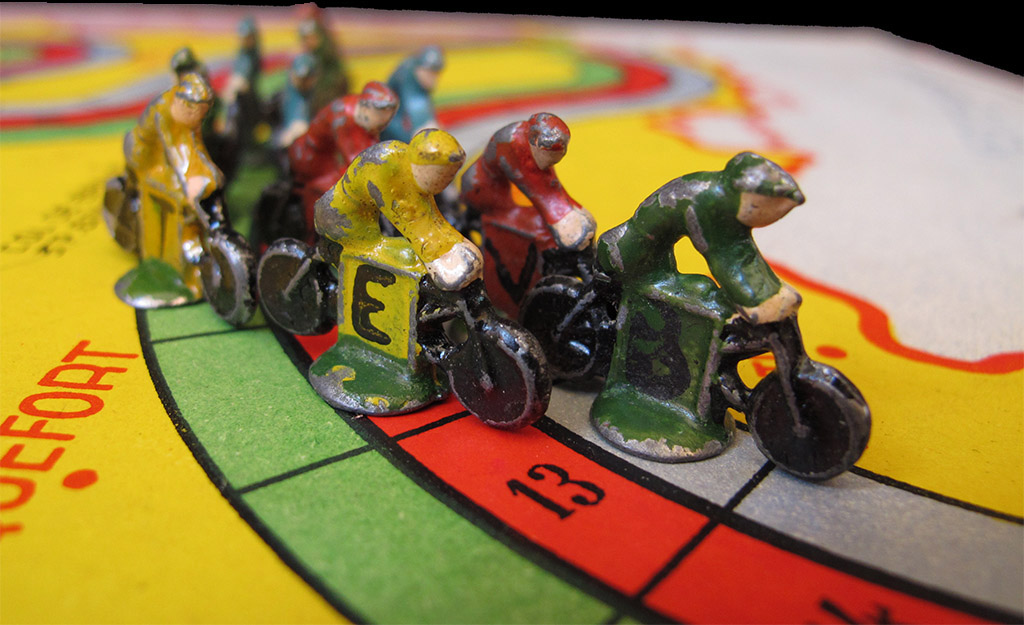
As said above, this game represents a 10-stage Tour de France to be played in a single session: what I call a "short stage-race game" in which short, simple stages are played in a single game session. Here, the road has three lanes of different colour. At the beginning of each stage, each player places one cyclist in each lane, and cyclists cannot change lanes during the stage, though they may be placed in a different lane in other stages. The game is played with two dice, a standard D6 and a special colour die with three faces with colours (red, blue, and green) matching those of the lanes, plus a white face, a yellow face, and a face marked with a "P". This special die determines what cyclist will be moved: if it shows the colour of one lane, the rider placed in that lane advances the number of spaces indicated on the regular die; if it shows white, the player chooses which of his three riders moves; if it shows yellow, all three riders move; if it shows a "P", the player does not move any rider in this turn. The only tactical decision is taken in case of throwing a white face on the special die.
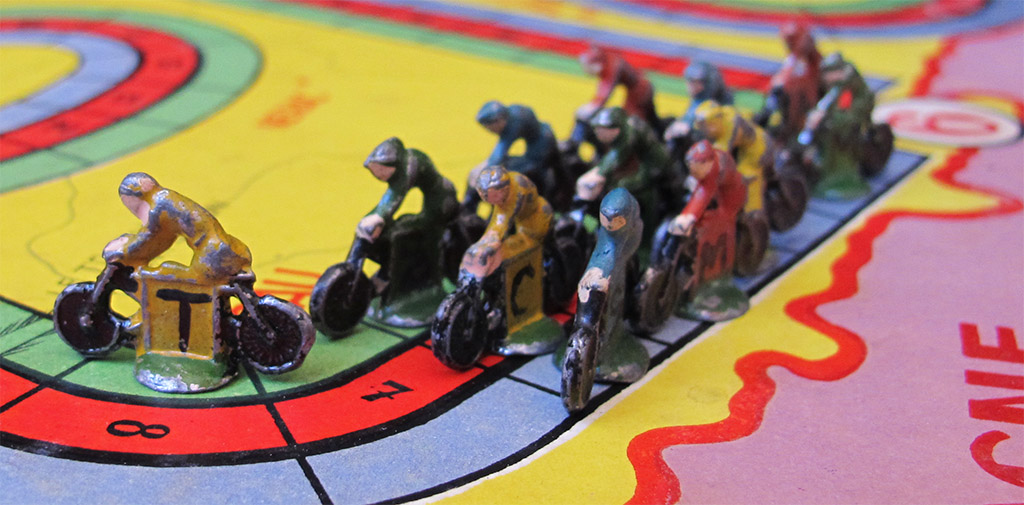
Two cyclists cannot occupy the same space. If a rider ends his movement on a space occupied by another rider, he moves one square forward (or more if the next space is occupied too). This is an interesting rule, since it suggests drafting, while in most games a rider who finds the road blocked stays behind the blocking riders.
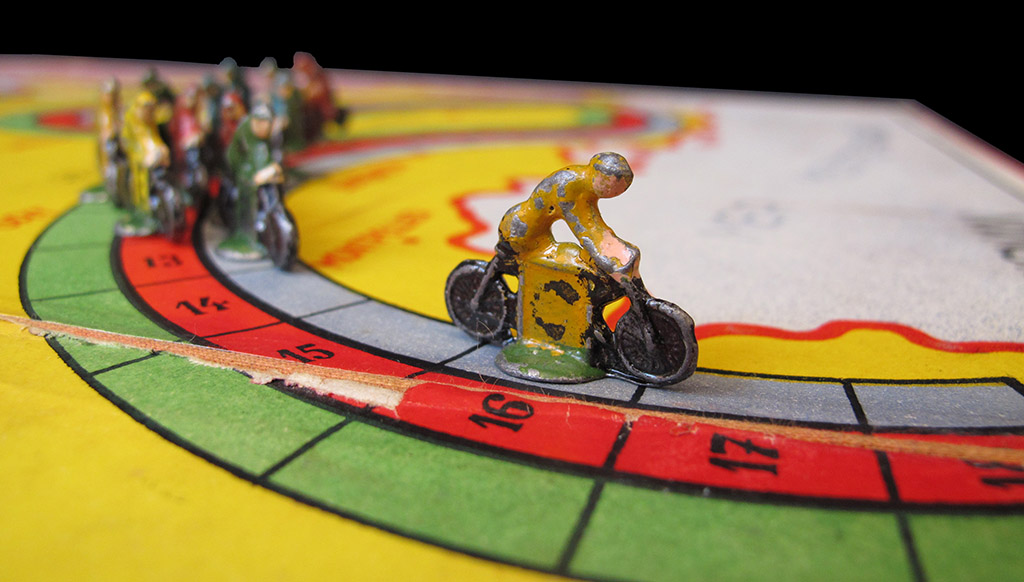
At the end of each stage, every rider receives the number of points corresponding to his position, except the winner of the stage, who receives a bonus (negative points) equal to the number of spaces between him and the second rider. Furthermore, there is a bonus of three (negative) points for the first rider to cross the mountain passes. At the end of the game, the winner is the rider with fewer points. Besides, there is also a team classification.
Stage 8 is supposed to be a (team) time trial. However, the time trial rules are not clear; the bonuses are different, but that is how far the rules go. In the actual 1935 Tour de France there were a lot of time trials: To quote from Wikipedia, "Stages 5, 13, 14, 18, 19 and 20 are retroactively seen as split stages, always between a standard mass-start stage and a time trial stage. In 1935, the mass-start stages were seen as a normal stage, and the time trial stages were not numbered. Stages 5b, 14b and 18b were individual time trials, while stages 13b, 19b and 20b were team time trials. In the team time trials in 1935, cyclists started together in teams, but unlike current team time trials it was the individual time that counted; the team time trial was not won by a team but by a cyclist."
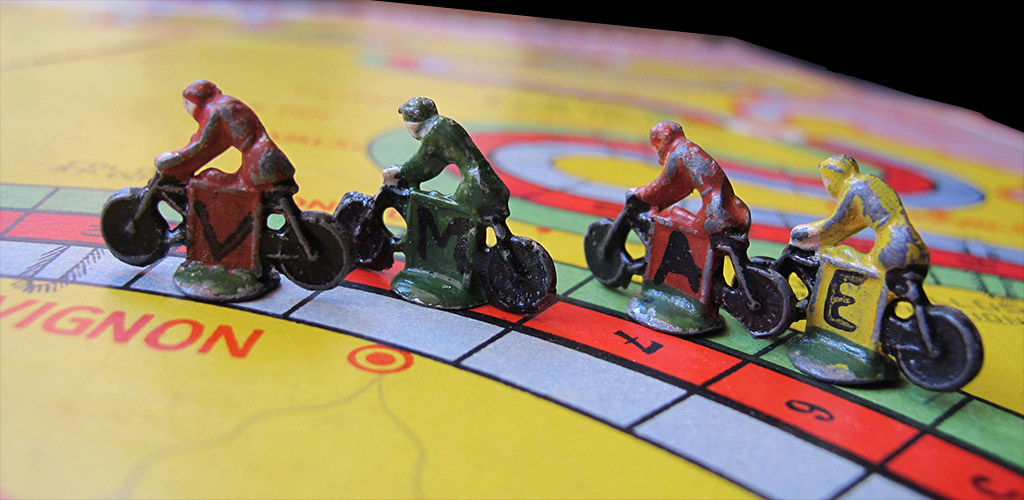
A weird thing about this game is that the numbers on the fields are upside down. It is not that the riders are placed in the wrong sense in the pictures. I do not see any explanation for that, or else I have not understood the rules of the game.
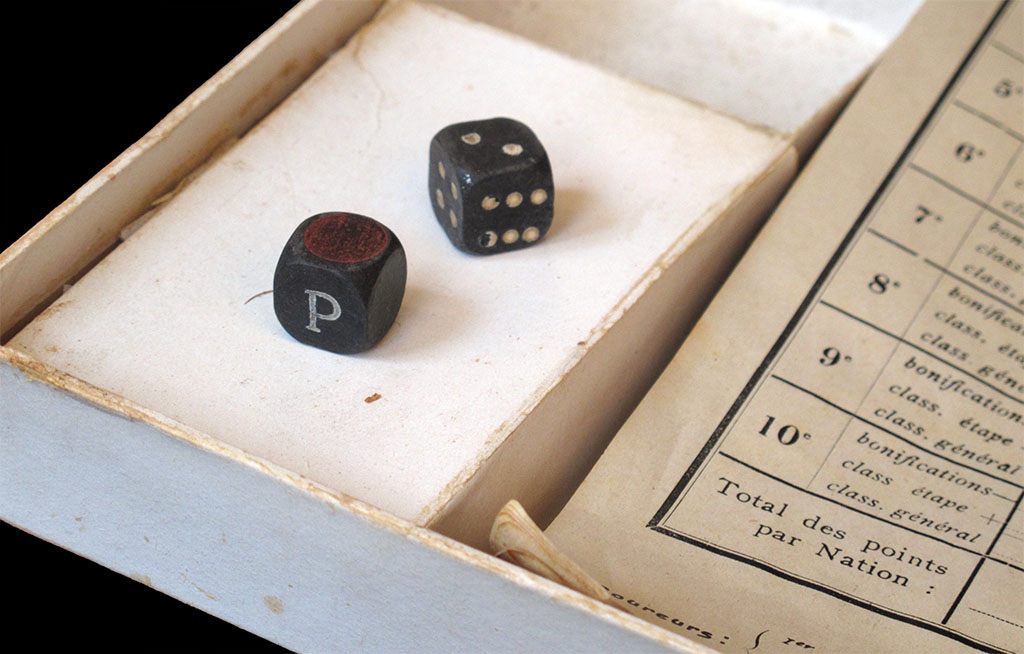
The colour die is somewhat faded. I will have to replace it when I want to play the game.
While the only possible tactical decision during the stages is in the case the coloured die shows the white face, there might be some tactics involved in the placement of riders from the second stage onwards, as placing a rider on the same lane of a certain rival might be slightly beneficial. However, the order in which players place their riders is not mentioned in the rules.
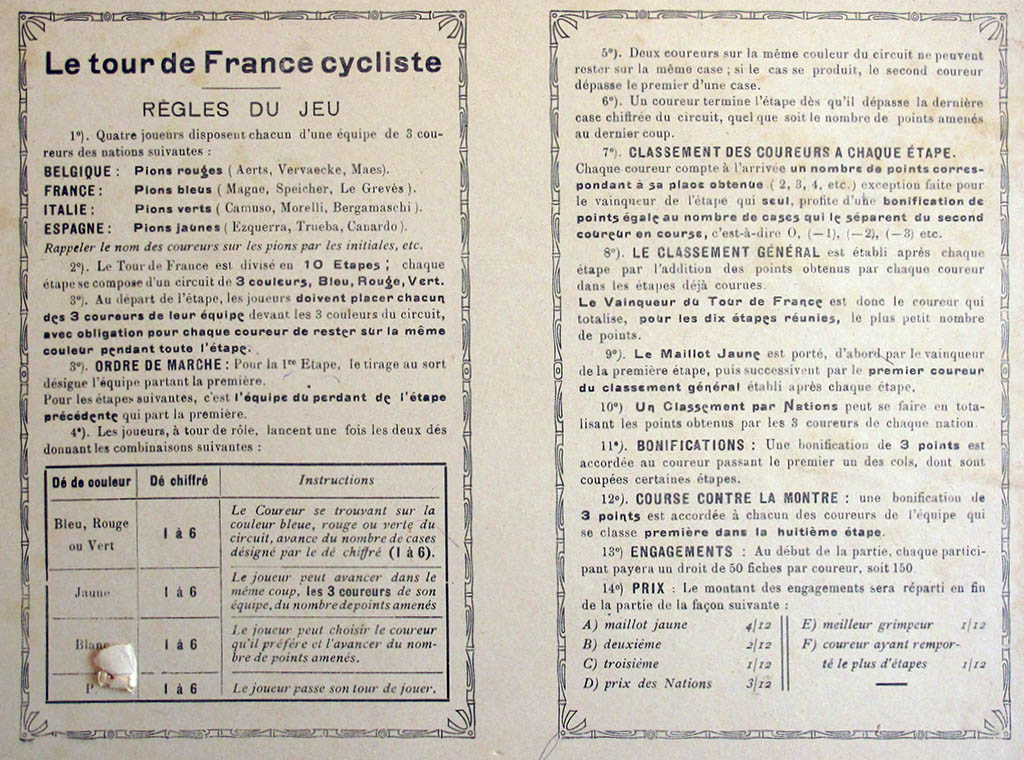
The rules, pasted on the back of the box lid, mention a "maillot jaune" to be worn by the leader of the race. This is a feature quite usual in many games that represent stage races. Generally, this is implemented either by an extra cyclist, which replaces that of the leader of the race, or by an implement, which is placed on the leader's cyclist. However, there is neither in my copy of the game nor in any of the copies I have seen. I am almost sure that, if there were an extra rider, I would have seen it before (not to mention that the Spanish team is already yellow), but I might have missed a small yellow "jersey".The rules also mention counters to be used as game money. There should be 600 such counters. I sincerely doubt that anything like that was ever included in the game. However, both in the case of the counters and of the "maillot jaune", please contact me if you know better.
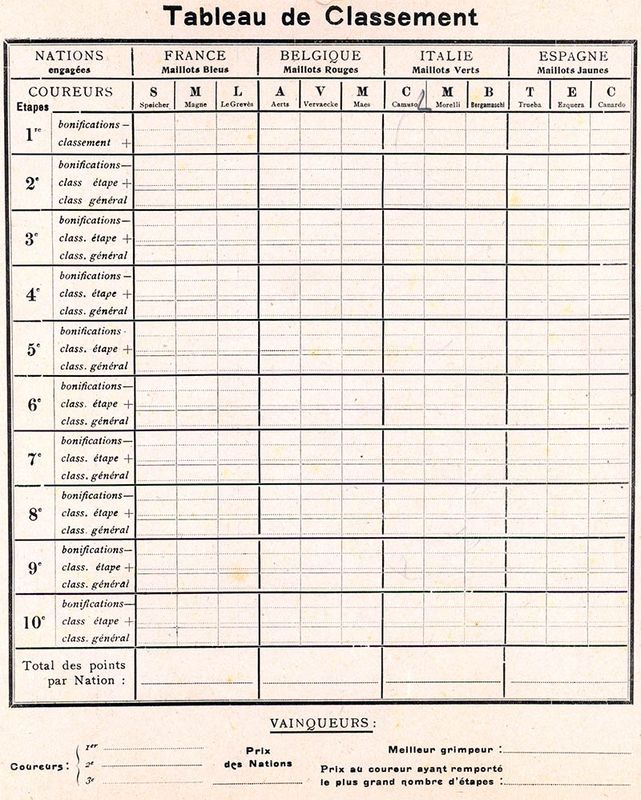
A rare unused score sheet
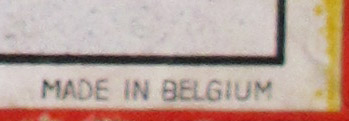
The inscription "Made in Belgium"
Thanks, Mathilde, for gifting me your father's cycling games.
Description written in April
2026.
 |
 |
 |
 |
 |
|
CULTURE IDEAS |
TOTUM REVOLUTUM THUMBNAILS |
NAMES ALPHABETICAL |
CATEGORIES LISTS |
WHAT'S NEW BLOG |