THE GREAT BICYCLE RACE
(ADDISON-WESLEY DESTINATIONS IN SCIENCE)
David C. Brummett / Addison-Wesley, USA, 1990s
This game is part of Addison-Wesley's 'Destinations in Science', an elementary school science textbook and activity programme published around 1995 for grades Kindergarten through sixth grade. This game is stated to be "for ages 8-12", but I have seen it advertised as a "companion book (sic) for 3rd grade". For those not familiar with US education system (and I am not, so I could be inaccurate on this), in third grade, children are usually 8–9 years old; kids start 3rd grade at 8 and turn 9 during the school year. In my opinion, the game might be adequate for 8-year-olds, but not so much for older kids.
It is a game that I was not sure whether it belonged here, and I admit I did not care to find out until I received the copy from François Cardinet's collection. And, well, after all it is a racing game, and it features (or, at least, mentions) bicycles, so here it is.
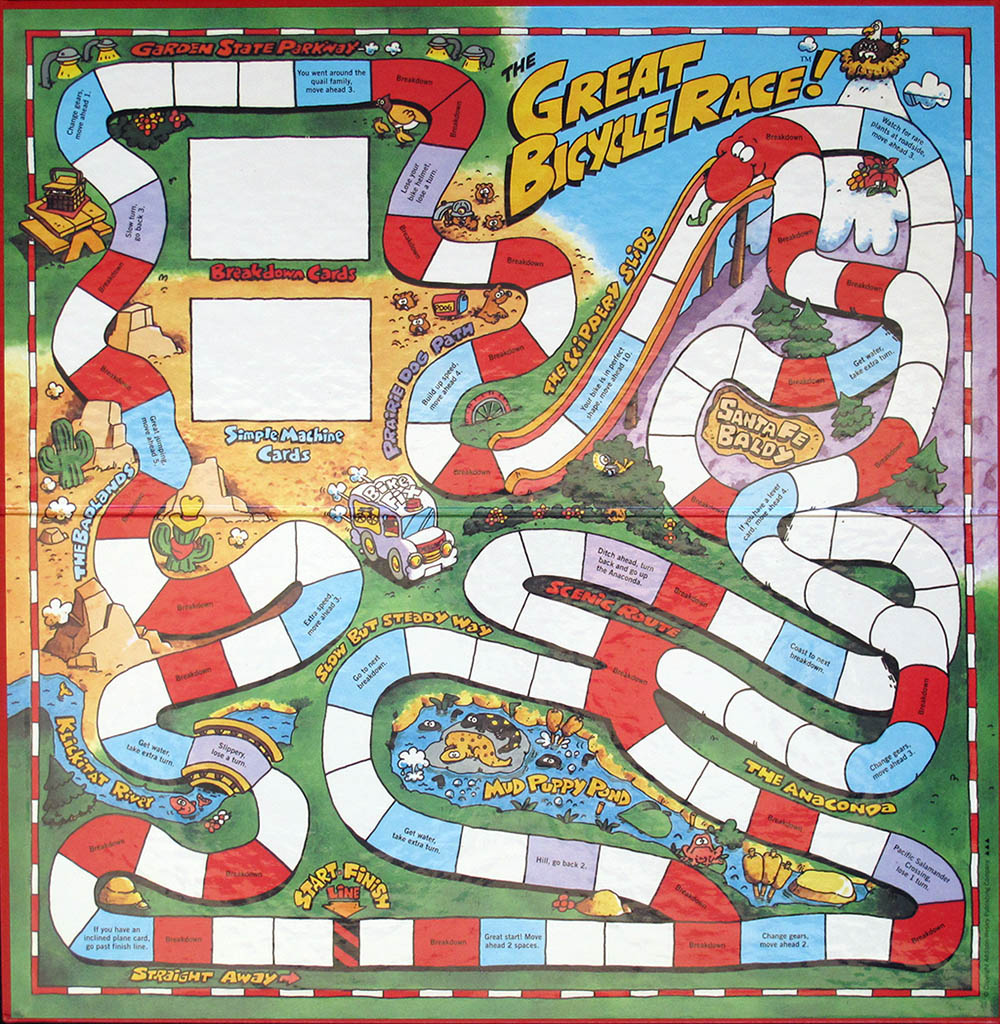
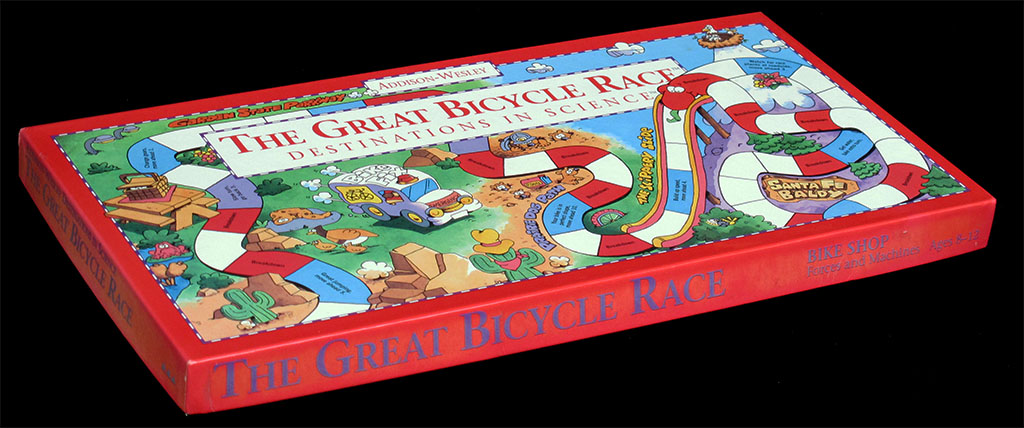
The game is quite big (the box measures 52 x 27 x 3.5 cm, while the board is 51 x 51 cm) and apparently sturdy, which is quite convenient since it is meant to be handled by 8-year-olds. However, this sturdiness is only apparent. The box and board are sturdy, but the counters are simple plastic pawns, the cards are quite flimsy, and I wonder if the spinner will resist many plays.
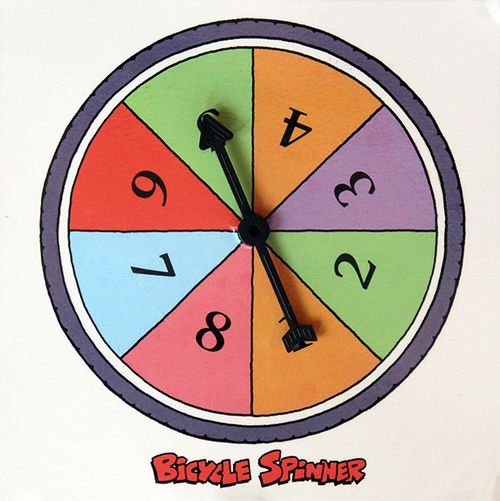
No dice in this game, probably not to offend the most conservative parents who associate dice with gambling.
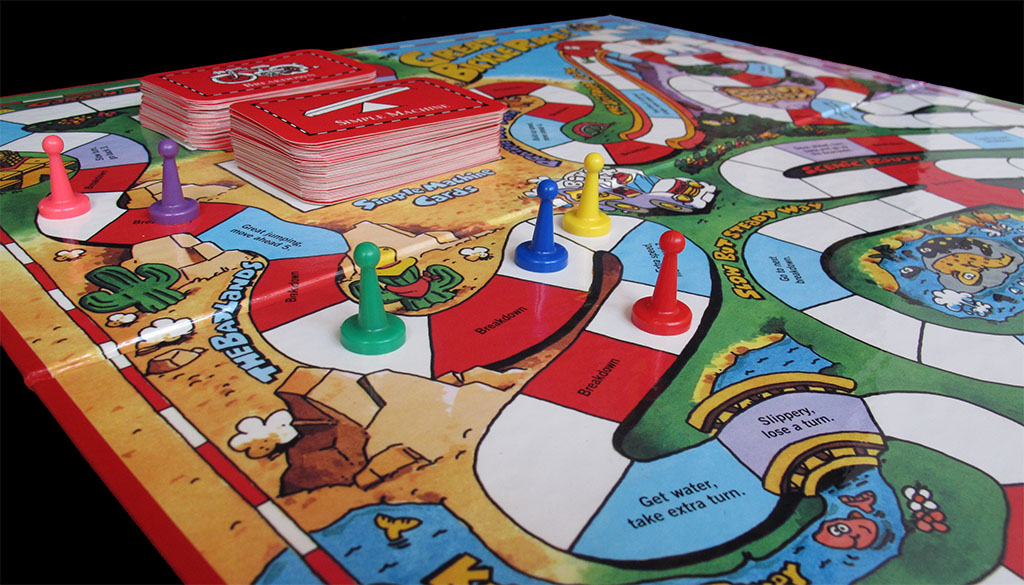
The counters are simple plastic pawns.
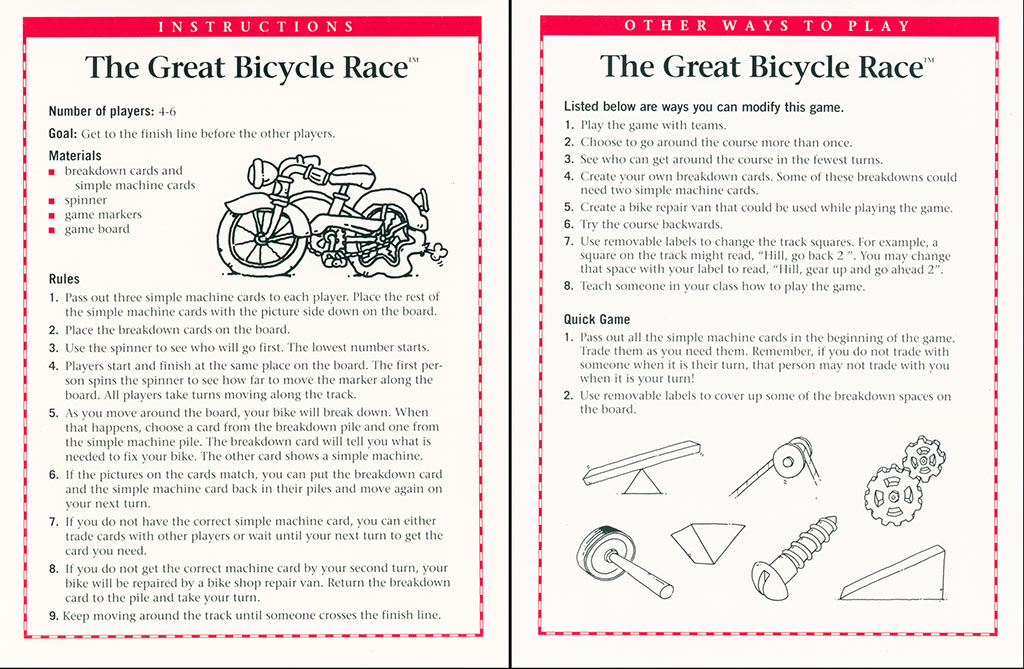
The expected simple game instructions ("lose a turn", "move ahead 5", and so on) are inscribed directly on the board. However, the singularity of this game is that when a player falls on a red square, he draws a card from the Breakdown deck and one from the Simple Machine deck. If the cards do not match, he can either swap the machine card with another player or else miss a turn and draw another card in the next turn. If the problem is still unsolved after this second turn, the bike will be repaired by an imaginary "bike shop repair van".
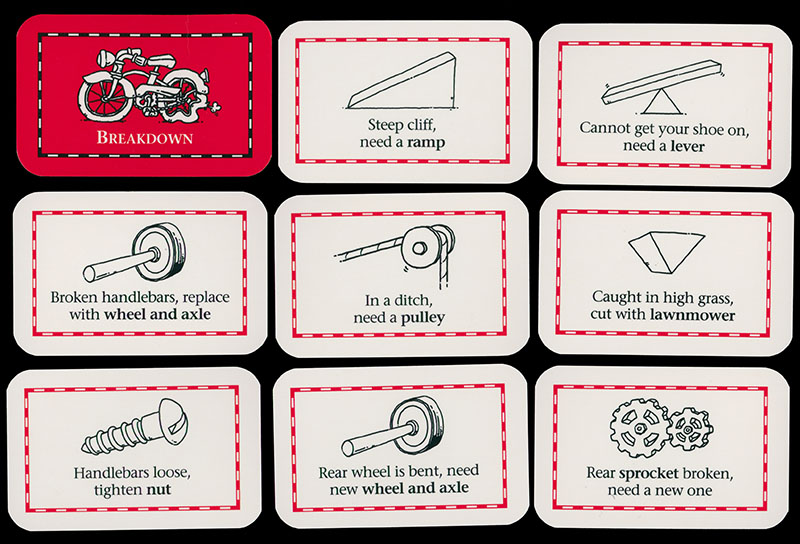
Breakdown cards: all kinds of trouble awaiting.
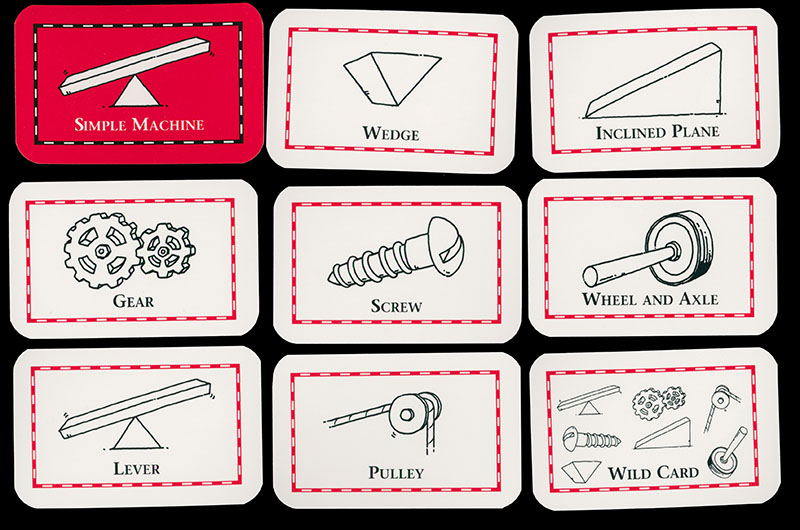
Simple Machines: a different solution for every problem.
You can modify the game at will. Of course, that is something you can always do with any game. In this case, however, it is specifically stated, which has an undeniable educational value ("learn to twist the rules if needed" or, ultimately, "you do not have to follow the instructions you receive if you know better"). On the other hand, it does not convey a high degree of confidence in the game's rules.
If I were to change the rules, I would skip the repair van (or at least delay it some more turns) so that a player stuck by a breakdown will possibly collect enough tools to go unscathed by the next few breakdowns and thus make up for lost time.
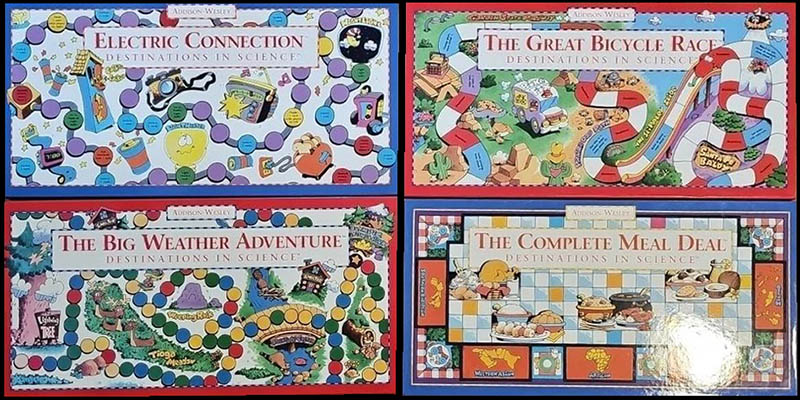
There are at least three other games in this series.
Thanks, Mathilde, for gifting me your father's collection of cycling games.
Description written in October 2026.
 |
 |
 |
 |
 |
|
CULTURE IDEAS |
TOTUM REVOLUTUM THUMBNAILS |
NAMES ALPHABETICAL |
CATEGORIES LISTS |
WHAT'S NEW BLOG |