
LUSTIGES
RADFAHRPIEL
VON LOTHAR MEGGENDORFER
Lothar Meggendorfer / Gustav Weise, Germany, 1890s
This is a gorgeous turn-of-the-century game by famous German illustrator Lothar Meggendorfer. Of course, Meggendorfer (1847-1925) is better known for his pop-up books, but he also illustrated a number of games, among which we find this one.
Dating these games is always tricky since we have little reliable information. We know that Meggendorfer was already famous when this game was made since his name is displayed quite prominently on the box, but that does not help much since Meggendorfer was already famous when he was quite young.
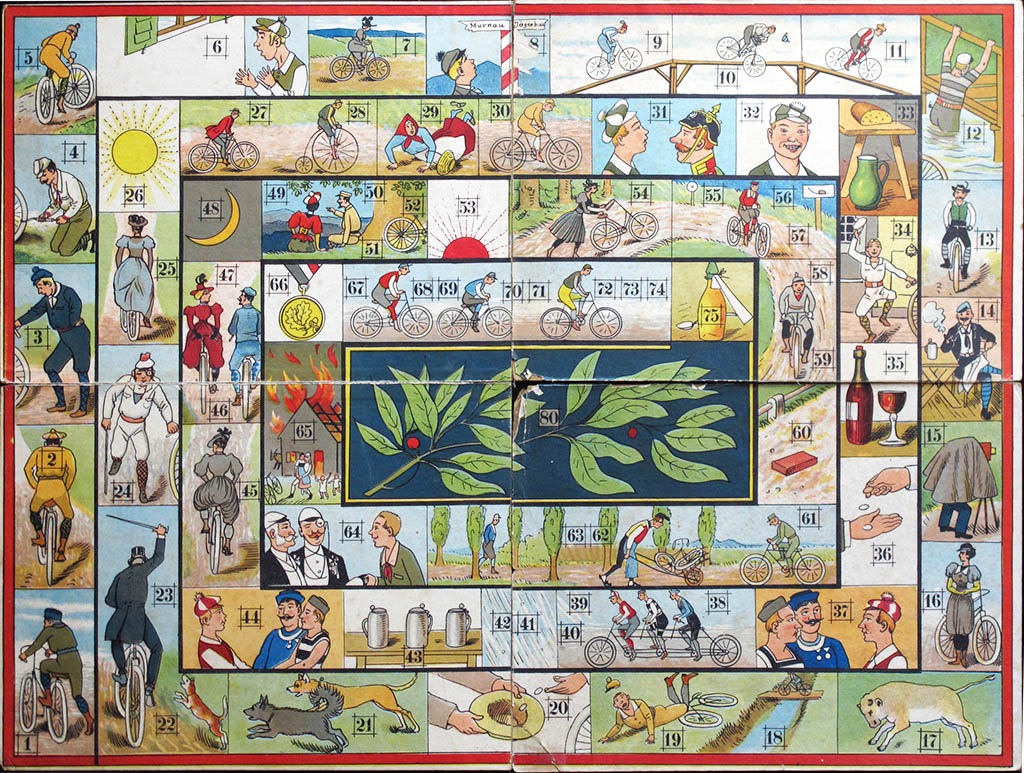
The box measures 36 x 28 x 5 cm and the open board measures 61 x 47 cm. Unfortunately, I do not have the rules of the game, but I guess it is safe to place it in the games-of-goose category.
By the way the cyclists are dressed and by the presence of big-wheel velocipedes, my guess is that the game was made sometime in the 1890s.


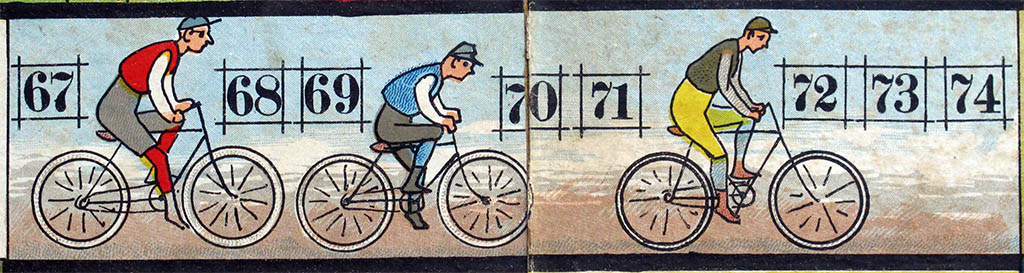
This triplet also looks from the 1890s

Watch out!

Cycling was more important than we generally remember for building a feminist revolution in the 1890s. The Victorian dress was quite impractical for riding a bike, and as early as 1881 the Rational Dress Society was formed in London, and the first Lady Cyclists' Association (also English) dates from 1892. German women were not too far behind the British in their demands.


Pneumatic tyres were invented by John Dunlop in 1887. They spread rapidly in the cycling world and were one of the main factors that ushered the bicycle craze of the 1890s. Of course, punctures also date from this time.

Falls, on the other hand, have always been there.


There should be 6 figurines in the box, three male and three female (see below). Unfortunately, I only have one. It measures 5.5 cm and, apart from the fact that it is beheaded (as is not unusual in old metal riders), one can appreciate some details in the bike that are consistent with the game being from the 19th century.

A ghostly beheaded rider

In this picture (found on the web) you can see a complete set of riders
UPDATE 2026:
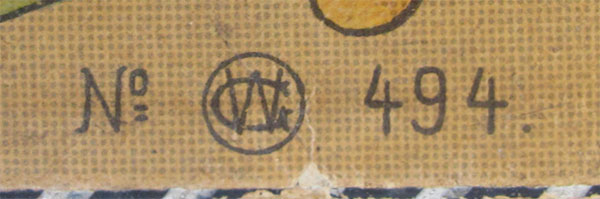
Siegfried L remarks that the publisher of this game is Gustav Weise, from Stuttgart, a company founded in 1863, and that this game is number 494 in his production, as seen on the little logo (that I had completely overlooked when I wrote this review some years ago) found on the bottom right corner of the box lid. Unfortunately, there isn't much information about Gustav Weise that would help us date this game better.On the other hand, it is easy to find information about Lothar Meggendorfer. I stated (see above) that he is better known for his pop-up books, but Siegfried adds that he was an extraordinarily prolific game designer who designed more than 70 games. Julius Beck, a friend of Meggendorfer (and designer of the Neues Lustiges Rad-Fahr Spiel), in a 1897 article for Meggendorfer's 50th birthday, wrote that Meggendorfer had (already) designed about 30 games for Gustav Weise. In the Wikipedia list of Meggendorfer games, the Lustiges Radfahrspiel is the 5th of 12 Weise games, but unfortunately no year is stated for any of these games. (It is interesting to notice that the list includes only 10 games of other publishers.) On the other hand, the Brettspielmuseum website gives a year for two Weise games: 1998 for game Nos. 525 and 1903 for games No. 550 and 551. (Four other games are dated "ca." and do not all follow chronological order).
If we assume that Gustav Weise's numbers indicate the order of release and that the production was roughly regular, this Lustiges Radfahrspiel game would be from the first half of the 1890s. Siegfried, according to this and to some subtle observations about the bicycles displayed in the game, estimates it to be from "ca. 1893".
Finally, as a divertimento, Siegfried also remarks that in this game Lothar Meggendorfer gave a hint about his place of residence: Meggendorfer was born in Munich, he died there, and maybe Munich always was his official residence. But he spent a lot (maybe most) of his time in a farmhouse that he owned in the pre-alpine region. The "Jägerhaus" (hunter's house) today is a hamlet of about a dozen houses that belongs to Bad Kohlgrub (west of Murnau, in the district of Garmisch-Partenkirchen). At the time Meggendorfer lived there, probably there were only a few houses. The official "Jägerhaus" building was founded as a recreation facility for monks and soon became a restaurant that was shut down only recently. As the sources tell us, Meggendorfer then ran a small farm, not a restaurant. Surely he lived in a separate house that wasn't the "Jägerhaus" itself. Siegfried adds that the signpost is depicted correctly, as Murnau is east of Jägerhaus; if we look to the south, we can see the Bavarian Alps (to the north, we see only hilly terrain). However, Siegfried admits that he did not check which exact place on the eight kilometres of road matches the profile of the mountains in the background, so he cannot tell the definitive location in which this signpost was placed.
Thanks a lot, Siegfried, for your instructive remarks!
Description written in March 2019.
|
|
|
|
|
|
|
CULTURE |
TOTUM REVOLUTUM |
NAMES |
CATEGORIES |
WHAT'S NEW |


