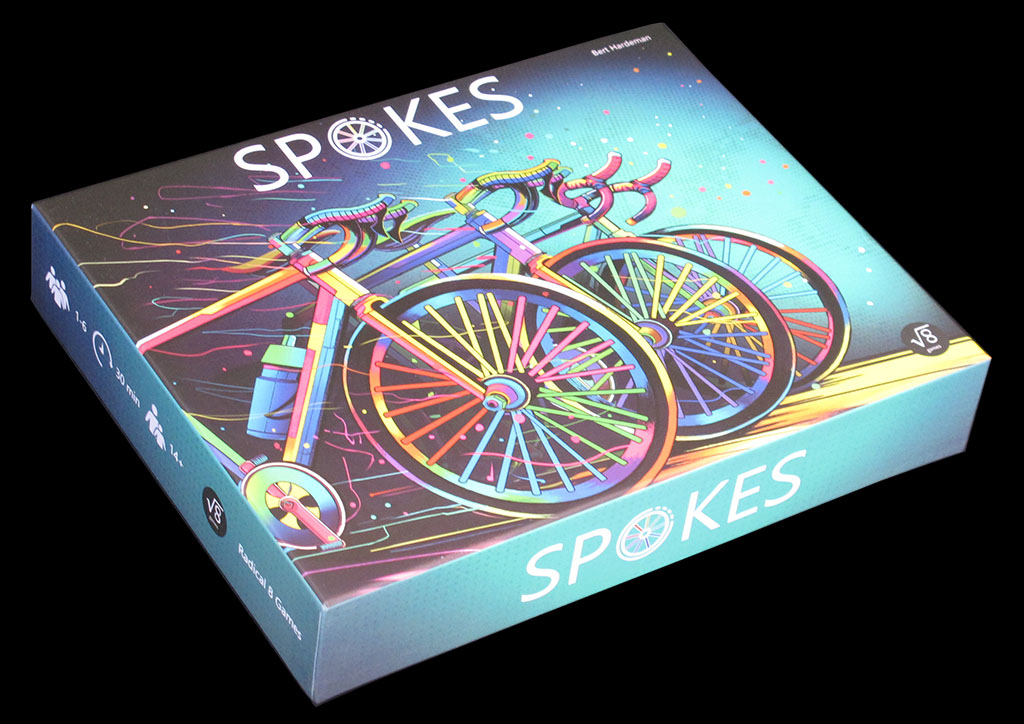
SPOKES
Bert Hardeman / Radical 8 Games, UK, 2025
While I tend to shy away more and more from crowdfunded games (for reasons stated here), I admit that I was immediately attracted to this one, if only out of curiosity before a game that was obviously different, and that I do not regret having backed this one, though my reservations about crowdfunding board games persist.What makes this game different is the core mechanics, described by the makers themselves as "simple mechanics which make players consider their choice of routes and how those will influence their stamina for future rounds". I basically agree with them, though I am not really sure about the choice of the word "stamina". Using again the maker's words, "in this game players race around the velodrome, changing the routes on the board with the spokes from their bike. As the game develops, new routes emerge, and management of energy as well as ingenious route spotting will see one player emerge victorious." Again, I am not sure about the "energy management", but I agree with the rest. I may even agree with him when he says that it is an elegant ruleset that is easy to learn but rewards clever play.
The game has a definitely innovative gameplay mechanic which does not use randomisers to produce the movement of the counters. It is well-tested too; it has been around for a while, and it shows. I do like this game. However, what I am not really sure is that this is a cycling game.Of course, this is a race game in which bicycle-shaped counters race around a velodrome-shaped track, with bicycle images printed on different game elements, including the game box. I have featured on this site games with fewer cycling elements. But do the ones in this game really make a cycling game? I mean, if you change bicycles for, say, cars, does something really change? Would you miss the bikes? My guess is that you would not, since this game does not have (most of) the necessary elements to distinguish it from other race games. (Slipstreaming, which is important in this game, is also a feature of car races).
Do not get me wrong. Of course, this game, with its current title and presentation, is a cycling game. Indeed. However, it could as well have represented a car race. What is worse, it would probably have been more "commercial" as such. If even a game that featured an unmistakably cycling-themed elimination race like Devil Takes the Hindmost had to be repurposed as a car race to be commercially released, I do not see why it wouldn't be the case with Spokes. I insist: while I do like this game, if you are thinking of buying it for the cycling ambiance, maybe it is not the game for you.
However, if you have a gamer's mind, if you are more into abstract games that minimise the chance element, and if you like games that offer something different, you should consider this one.
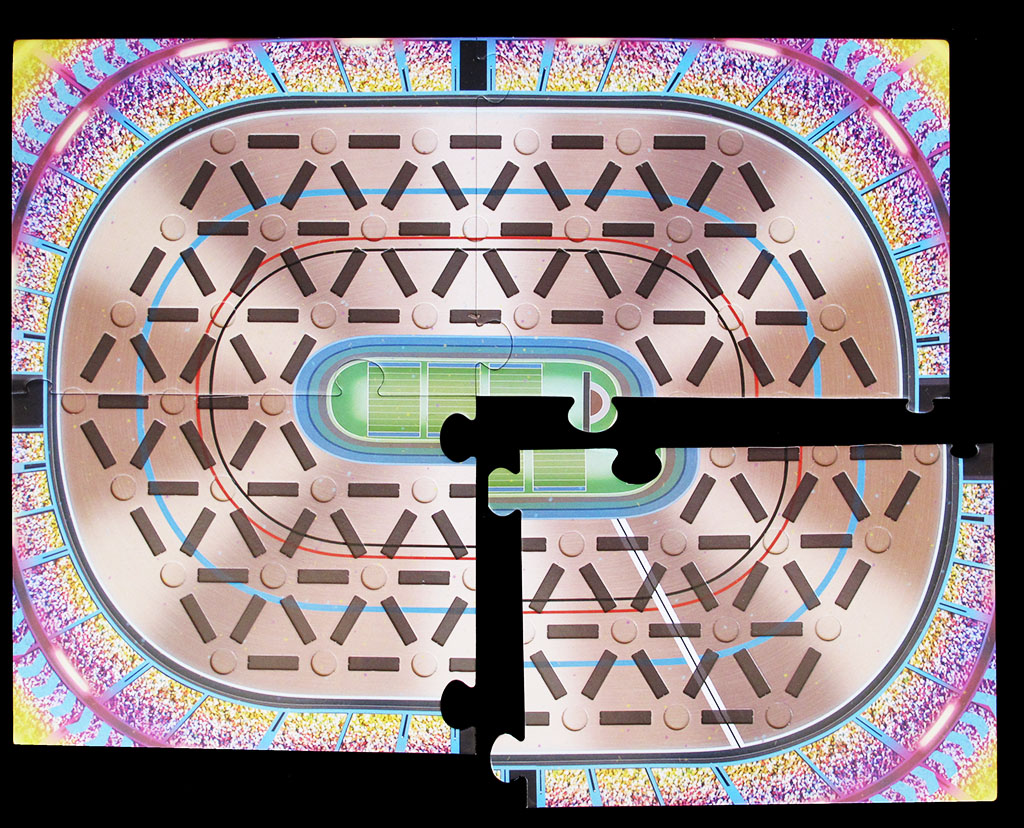
The board is jigsaw-style. When assembled, it measures 47.5 x 36.5 cm. It fits well in a quite compact box (28.5 x 22.5 x 5 cm).
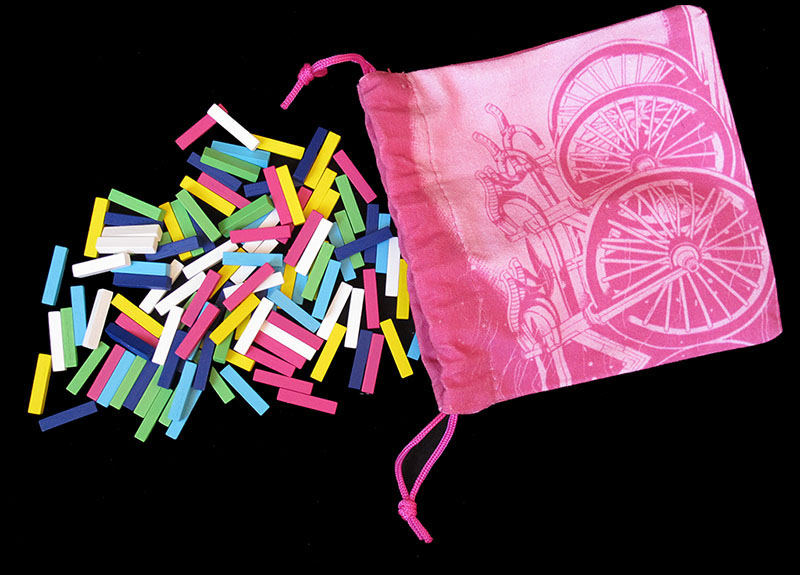
However, the game board is not complete without the 150 wooden "spokes" in six different colours which give the name its title and its distinctive flavour. These spokes are randomly placed on the board at the beginning of the game. This makes each race different, which is good for the game's replayability.
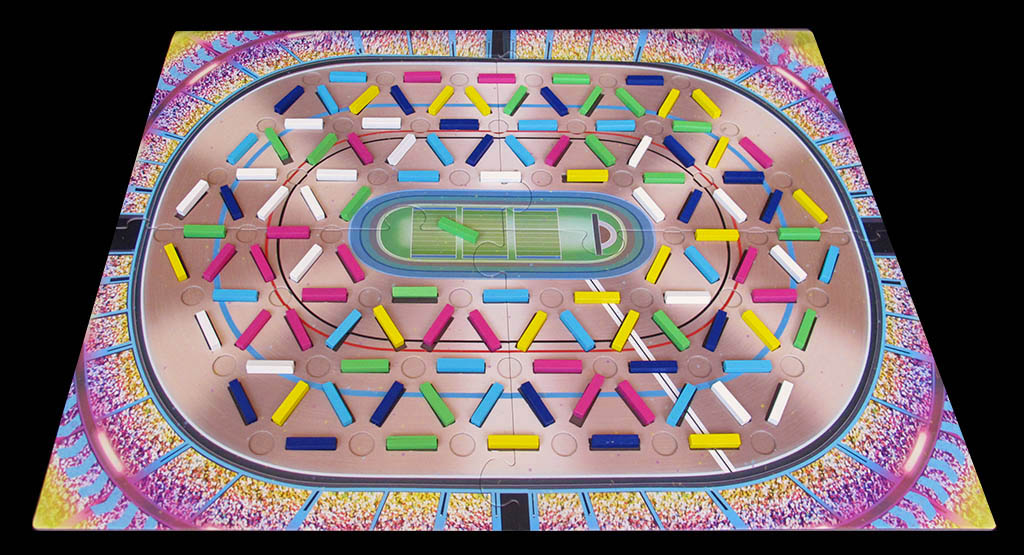
No wonder the game is described with words as "kaleidoscopic" or "colourful".
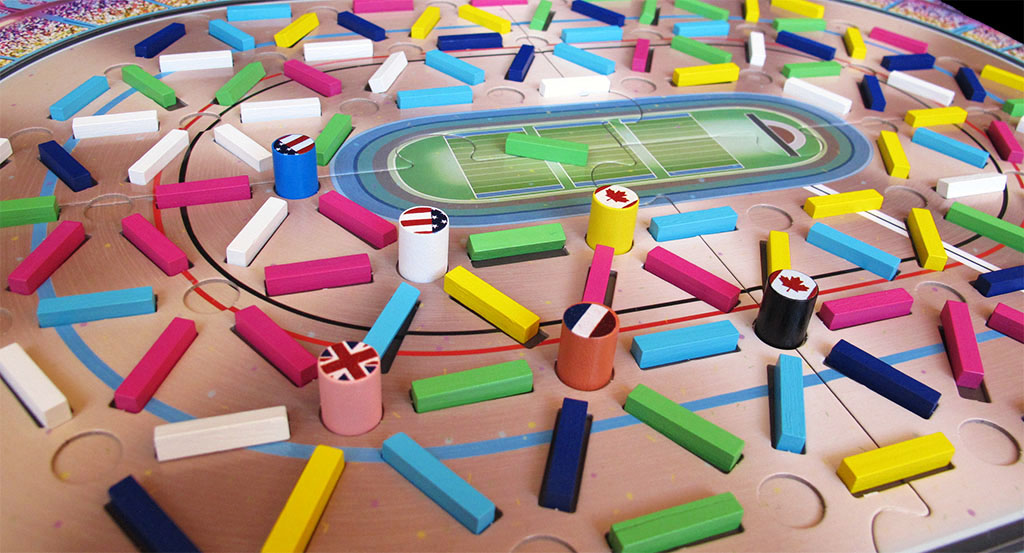
These "abstract" wooden counters are what you get with the basic version of the game unless you purchase the cyclist-shaped counters, which are sold separately. I do not think this is nice, but I did purchase them. And since I did, I feature them on all the other pictures. Scroll down to see them.
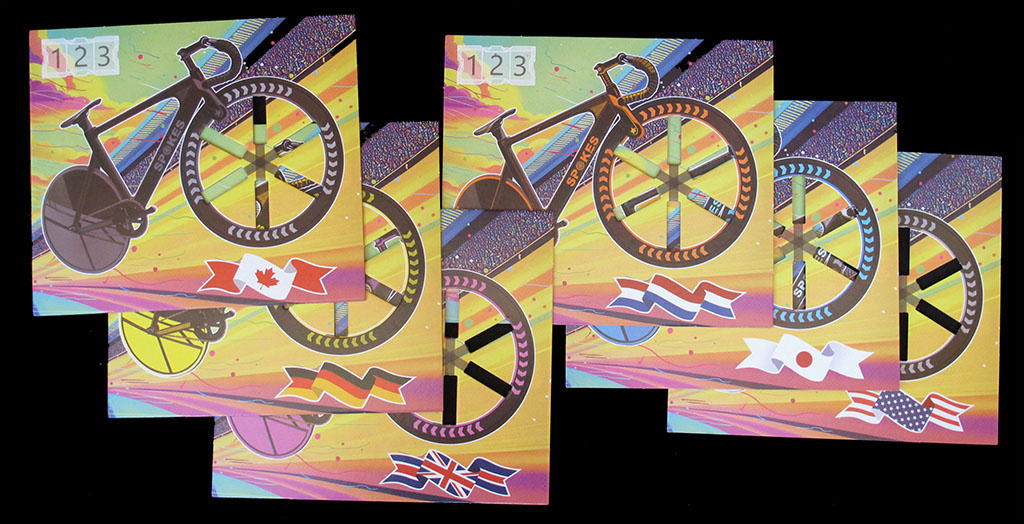
Each rider has his own playing board, in which you place six spokes. At the beginning of the game each rider has one spoke of each colour, but this will change during the race.
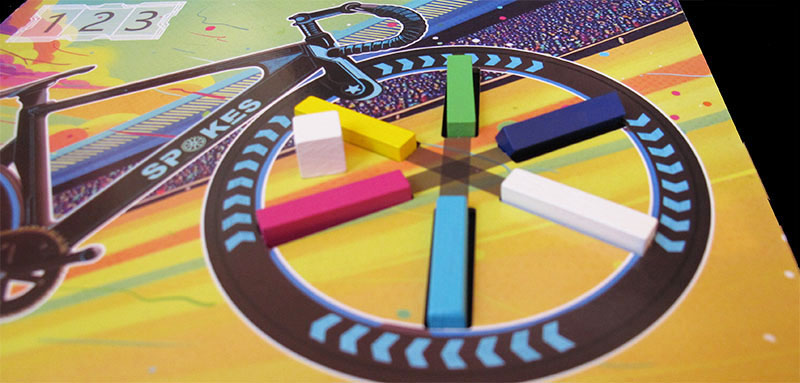
This is what the bike looks like at the beginning of the race.
You can only play one of the three spokes ahead of the marker. You swap that spoke with one on the board (of a different colour, hopefully), and you place the marker just after the swapped spoke so that on the next turn you will have a different subset of spokes to choose from. Then you move the rider across a one-coloured path on the board which shall include the spoke you just placed.
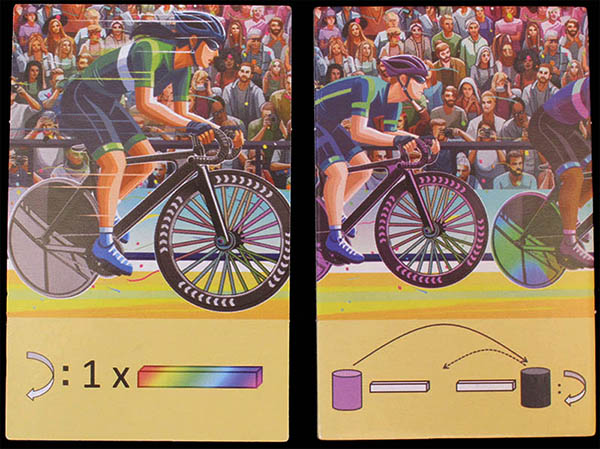
Each rider also has these double-sided slipstream cards. When you do not complete your movement, you turn the card. When the card is turned, you may include one (and just one) spoke of a different colour in your movement in a subsequent turn before turning the card back to its original state.
With a clever use of the colours, paths in the track are built and become longer and longer. You can say that "the track gets faster" as the game progresses. The race is run over three laps, and the last one is very quick, a kind of sprint. I admit this is quite "cycling", at least when explained, but I still find it more "abstract" than "cycling". Just my opinion, though.
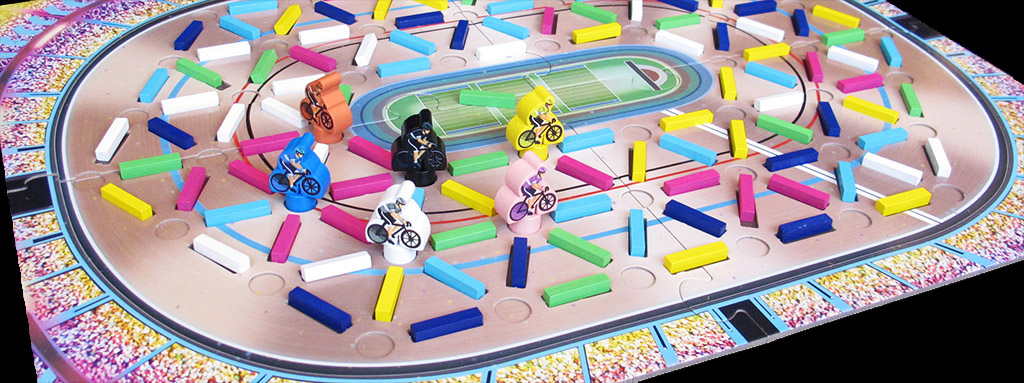
Here are the wooden riders. They are 23 mm long.
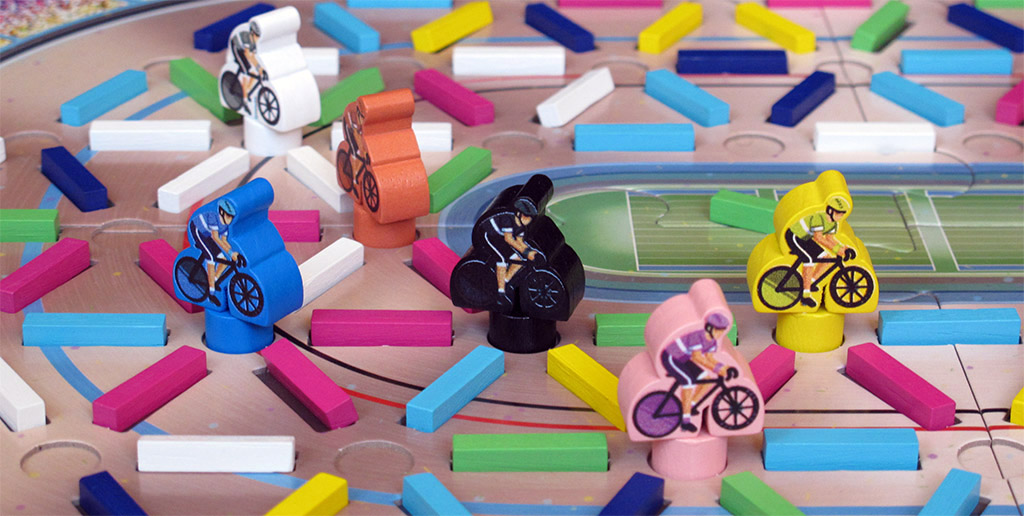
A closer view.
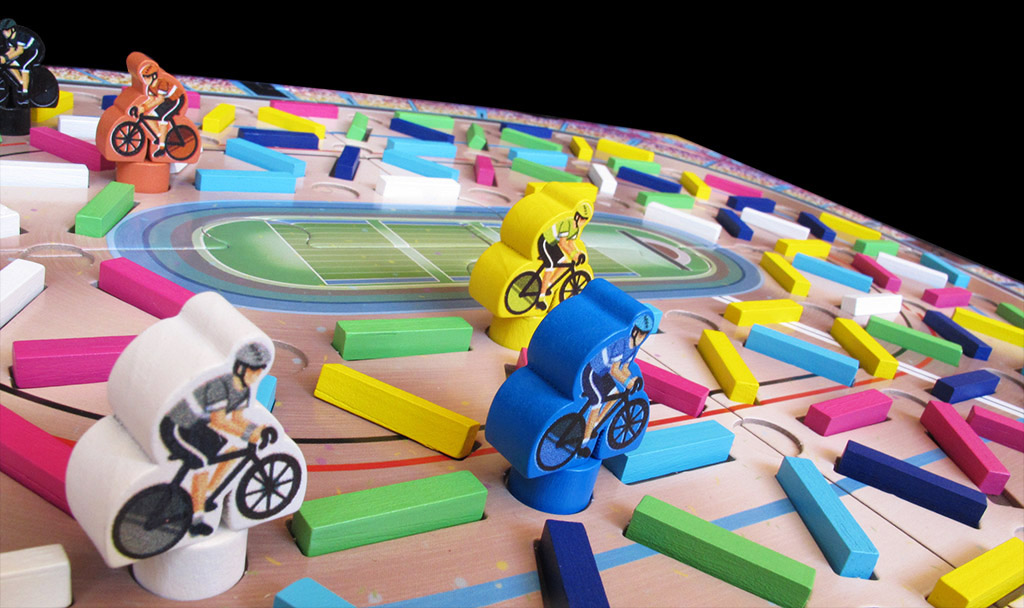
The game rules are available on the Radical8Games website, but they are not easy to find; you may need a certain amount of link following before you find them. I could add the link, but that would spoil the fun of some old-time internet navigation when we followed links, jumping from site to site, from "island" to "island"; that's why it was called navigation. Of course, you can ask me if you don't find them.
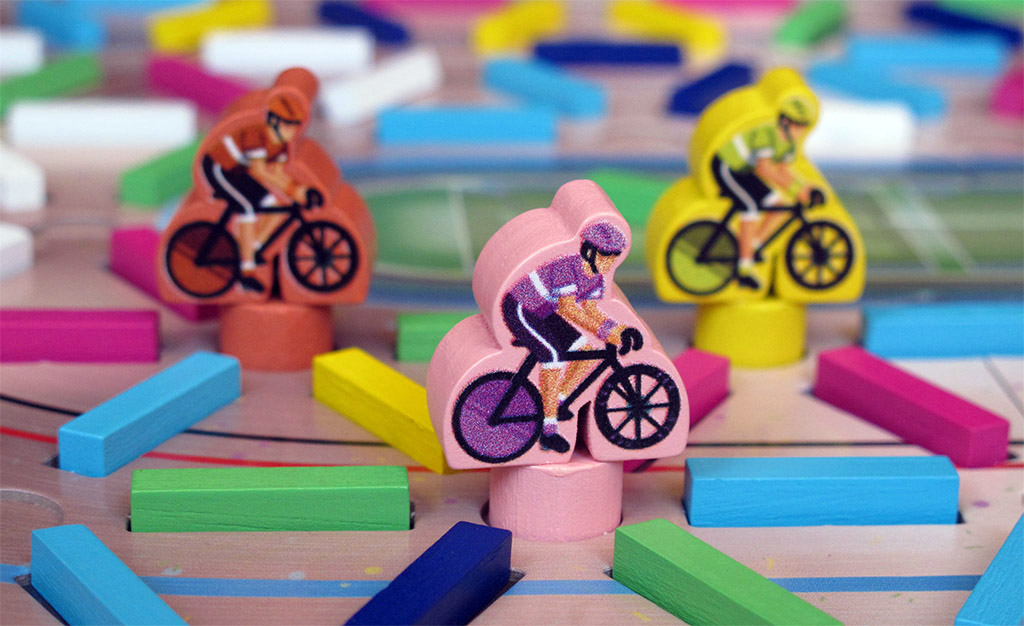
The cyclists look quite good, don't they?
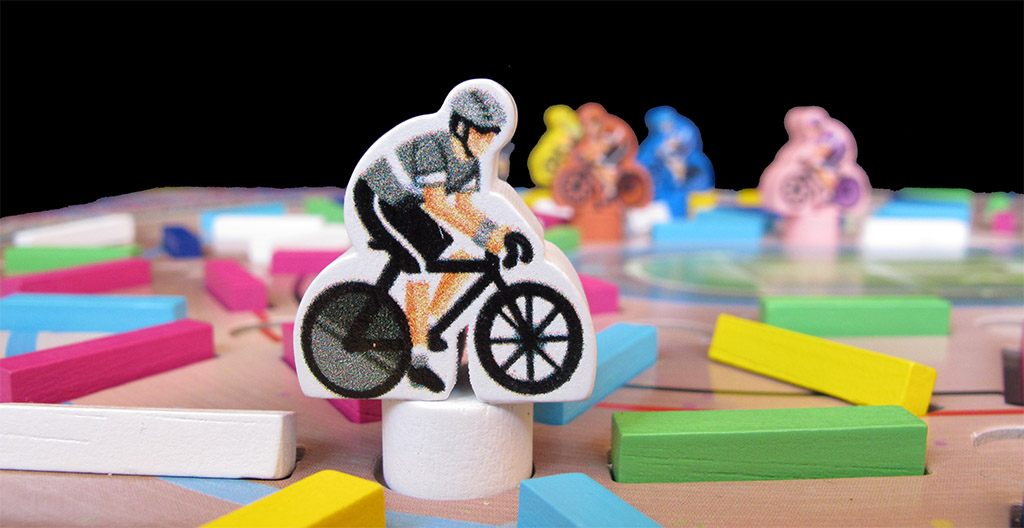
The white rider in close-up.
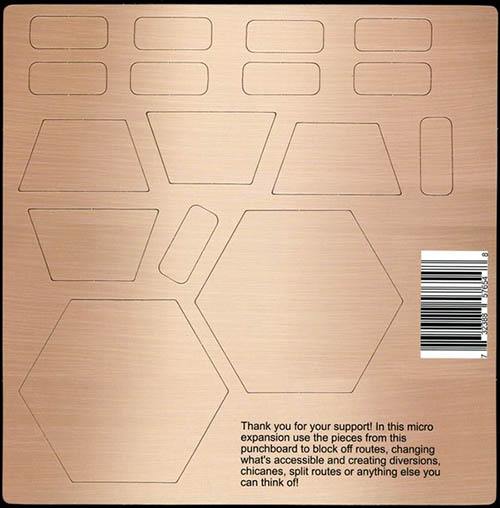
Since I backed the game on the crowdfunding campaign, I received this punchboard (called the "Track Change micro expansion"). As you can read, you are supposed to place some obstacles on the board to spice up the game. Another good replayability point, I guess. However, I have not played the game that much yet, so I have not tried it. Besides, I find it quite "uncycling", don't you?
Check the Radical 8 Games' website
Description written in April
2026.
 |
 |
 |
 |
 |
|
CULTURE IDEAS |
TOTUM REVOLUTUM THUMBNAILS |
NAMES ALPHABETICAL |
CATEGORIES LISTS |
WHAT'S NEW BLOG |